Current Location Today

East of Tonga, South Pacific

Welcome Everybody

Hello - Welcome to my Blog. This Blog is to provide a virtual diary my travels and experiences whilst I strive to photograph wildlife and nature throughout Australia and aboard. I hope you find the Blog interesting and the content and images cause you to reflect on how important it is preserve natural places and their inhabitants.

For me photography of the natural world is more than just pretty settings and cuddly animal photos. It's a concern for the environment and the earth all living creatures must share.

My Favourite Animals

Albatross, Bobcat, Coyote, Wolf, Raven, Shark, Goby, Turtle & Nudibranch (marine).

But all animals are beautiful and deserve protecting and conserving.

View Anaspides Images


Search Photo Stock Library


www.flickr.com


Subscribe, Share & Save

Share/Bookmark

 Subscribe by E-Mail

Think Green, Work Green, Be Green
Brighter Planet's 350 Challenge Wildlife Photography Blog Nature Blog Network

Coyote photographed at Yellowstone National Park (NOT captive)

Entries in Tasmania (12)

Tuesday
Apr202010

Tasmanian Wildlife Carer Rehabilitates Australian Short-beaked Echidna 

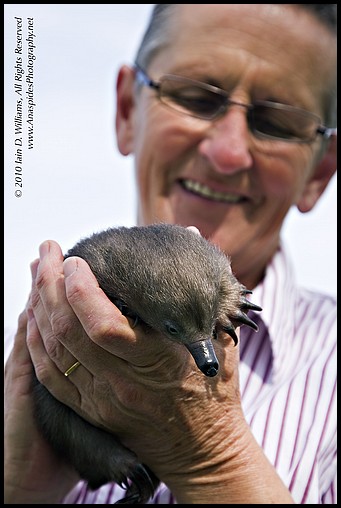
Recently I was asked to photograph a small Australian Short-beaked echidna (Tachyglossus aculeatus) that been found alongside a walkway in southern Tasmania.  The young orphan had been discarded by its mother for some reason and a “good samaritan” had found the nymph and passed it along to “wildlife carers” to nurture and hopefully rehabilitate to the wild. 

Observing let along photographing an echidna this young is uncommon; usually they are still in the mother’s pouch (actually a fold of skin) or are left in the burrow whilst mother is out and about searching for food.  To see a very young echidna usually means that the mother has been killed or has “dumped” the baby for some reason.  Echidnas frequently are killed by vehicles along roads and by farming practices (farming ploughs often dig up mother echidnas and their young), but in this case the mother was nowhere to be found.  Why the youngster was ousted from the pouch so early and what happened to the mother are questions that were to remain unanswered. 

LEFT:  Australian Short-beaked Echidna & wildlife carer pose for the camera - meet "Young Quills"

The wildlife carer cared for the baby echidna for several weeks feeding the young urchin every 2-3 days with a specially brewed high protein, high fat milk which replicated, as much as possible, the milk that would have been supplied by the mother.  The milk is administered to the infant by a micro pipet usually used in chemistry classes to deliver defined and accurate volumes of whatever to a test tube.   The echidna, nicknamed “young quills” lapped up the rich liquid with his exceptionally long and sticky tongue; only becoming less active when his full was taken.  After the 10-15 feeding it was time to return to a long sleep to digest the liquid meal.

To house the echidna, a special basket was used that was lined with soft loose material.  The basket was kept in a specially heated room in an attempt to replicate the warmth of the mother’s pouch or burrow, and had a lid to ensure the inside was in more or less perpetual darkness.  The only time Quills was allowed to exit the pseudo pouch was for feeding.  Young Quills grew quickly and put on substantial weight and his fluffy fur was soon to be replaced with more defined fur along with the beginnings of the many spines that this critter is known for.  
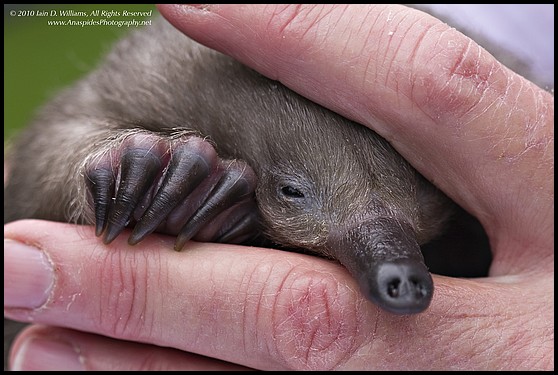
All seemed well for Quills and the next stage of the rehabilitation was being put in place.  It was planned that after reaching a certain size, Quills would leave his initial wildlife carer to be relocated to another carer whose task was to teach the young Quills how to search for and eat ants; the favoured food of the echidna.  Usually this would be done by the mother echidna (obviously), however, in this case a carer would have to act as a surrogate mother.  After a month or so of teaching, Quills would have then been released into the wild to fend for himself.

LEFT: The claws of Australian Short-beaked Echidnas are exceptionally sharp and strong.  Echidnas have the ability to burrow quickly beaneth the ground.

However, this was not to be!  Quills died in the early morning.  The reason behind his death was unknown; the carer had done everything in her power to look after Quills.  As baby echidnas are uncommon, the reasons for Quill’s death were important so that carers could learn from the event.  An autopsy was performed by a Government Veterinarian in an attempt to determine the reason for Quills’ untimely departure from the natural world.  Although nothing definite could be established, adhesions around the heart were found.  Whether this may have been a cause for the animal to be discarded from the mother is unknown. 
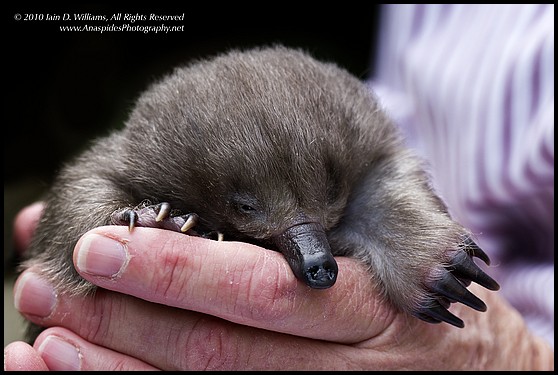
Wildlife Carers are located in all Australian states and donate their time to care for native animals in distress; often when food and medical supplies are low they dig deep into their own pockets to purchase essential items.  

LEFT:  Juvinile Australian Short-beaked Echidnas lack the basic survival skills until taught my the mother.

If you discover a lost or injured native animal, don’t ignore it.  Carefully remove the animal from danger (road, etc) and place it in either a darkened sack or a box with a lid.  It’s important to ensure the animal is kept warm, quiet and in darkness, as this will lessen the stress for the animal.

To contact a wildlife carer in Tasmania (Australia), call the Injured and Orphaned Wildlife Programme on (03) 6233 6556.  Feel free to make comments on this post in the comments section below.

Friday
Apr092010

Hunting Wild Tasmania Devils in the Night

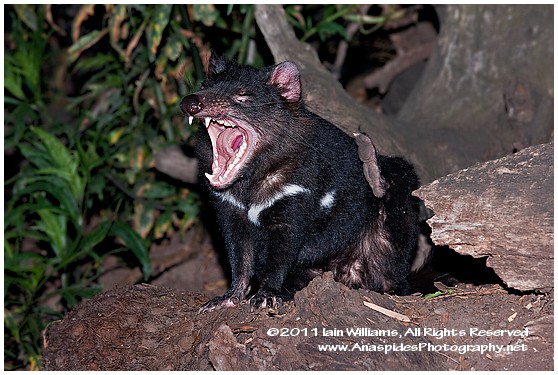
Tasmania Devils (Sarcophilus harrissii ) are endemic to Tasmania, a small island state in Australia.  Once common throughout forest areas, these nocturnal creatures are declining in numbers and have been listed on the IUCN Red List as endangered.  The reason for the decline and IUCN listing is the development of a viral disease called Facial Tumour Disease.  The disease, which is still being investigated and mapped, spreads rapidly amongst devils as they fight and argue amongst themselves for mating privileges and when competing for food. 

LEFT:  A wild Tasmania Devil pauses and looks about for potential predators.

Natural History – A Few Facts

Devils are the largest marsupial carnivore, roughly weighing the same as a largish medium sized dog.  They have excellent smell, can travel long distances in an evening in search of prey, and can eat 20 times their own body weight in one sitting.  They primarily feed on carrion, although live prey is often taken.  Their life span in the wild for roughly 5 years and they become sexual mature at 2-3 years.  Although devils appear vicious looking they are not; I’ve had wild devils sniffing at my boots and playing with my tripod legs!  Adding to their perceived vicious reputation is their loud cry which is very unnerving when heard on a dark night, and their rather poor table manners – devils argue over food and often have short-lived fighting arguments which can be quite intense and very loud.

Photographing Wild Devils- Equipment

Photographing wild Tasmanian Devils is not easy!  First you have to find them, and then they have to be receptive to you being in their space.  Further, shooting at night with flash and fixed light is not the easiest of activities as any budding photographer will attest to.

I use an assortment of equipment to photograph devil which chnages depending upon the environmental situation.  Usually I have two industrial style spotlights set up either side of the carcass.  It’s important to try and disguise the lights as much as possible and usually I’ll hide them in the bush.  The purpose of the lights is to allow the camera to acquire a focus lock easily on an approaching devil.  I’ve discovered through trail and error that some devils don’t mind the lights at all, while others shy away from them – it’s a personal devil thing. 

LEFT:  A Tasmanian Devils rips open the carcass in a frenzy to eat as much as it can before other devils join in the feast.

I always use a tripod and usually use a 70-200 f2.8 zoom lens or a 300 f2.8 lens attached to a Canon 1Ds camera. I use two Canon 580 EX speedlights.  One flash is mounted on a Wimberely flash bracket from the camera L-plate (main light) and the other flash (fill light) is mounted on a small tripod and set off to the side.  I sync the speedlights using two pocket wizards. To ensure that the speedlights are pointing exactly at the devil and not pointing elsewhere, I use a small portable red laser light.  The laser light ensures that the flash is pointing a exactly the place I want the artificial light directed.  On occasion I also use a better beamer and/or flash snoot to help funnel the light and not expose the background too much.  I always set the flashes to manual and rarely use ETTL.

Nocturnal photography of wild animals can be very hit and miss, especially when you must maintain your position and be relatively quiet.  Often if you relocate your position on the fly, and the devil is wary, it will run away and not return that night.

LEFT: A Tasmania devil part way through it's dinner on carrion, stops and looks about before screaming out loud to warn other devils that he has first dibs on the food.

Establishing a Blind & Bait

I’ve spent quite a bit of time photographing devils in a number of locations and by far the best method is to establish a blind of some description; my latest blind was a hole in the ground covered with a military style camouflage net.  On this particular night it was quite amusing, it rained filling the shell scape (a small hole) that I’d dug with water.  I can remember spending the night cold, wet and miserable until 3 devils came by to cheer me up. 

LEFT: A Tasmania Devil stands over carrion that has been securely staked to the ground.

There is no chance that you will photograph, let alone see a devil without setting bait.  I usually collect road kill and then securely stake it to the ground in an opportune area.  I then create a number of blood trails through the forest leading to the staked kill .  A blind can be almost anything from a shell scrape in the ground with a net, to hiding amongst bracken.   It’s important to reconnoiter the location of the blind as it must be downwind of the carcass.  Devils have exceptional senses of smell, and they will smell you a long way off if your scent is blowing toward the carcass.  I remember on one devil shoot the wind was blowing the wrong direction.  I could see the devils in the distance circling the bait, but they would not approach closely.  I decided to cover my clothes with the odour of dead wallaby, and this partly solved the problem, but they were still wary.

LEFT:  Tasmania Devil with Facial Tumour Disease (FTD) on face near jaw.  In the last 12 months I have witnessed a steady increase of devils with FTD in this area.

Patience

Patience is a virtue with devil photography.  Although devils are most active and hour after dusk and an hour before dawn, they can turn up at the kill at anytime during the evening.  Often you must put in long hours of waiting for a devil to turn up – and then there is no guarantee that the devil will feed on the carcass.  I’ve seen lots of devils appear, scout the location and then disappear into the night as quickly as they appeared!

Exciting Experience

I enjoy photographing all animals; however, there is something about devil photography that keeps me wanting to go back for more.  Perhaps it’s having to be patient waiting for a devil to appear, or maybe it’s the work you have to do before you even see a wild devil.  You have to establish a blind, find road kill, set the bait and then stay awake most of the evening; you also get VERY dirty and often are covered in odour and blood from the carcass.   Certainly, the work before the shooting begins makes any images taken far more worthwhile.

I certainly get a “buzz” when, on a dark drizzly night, you see a white blaze in the darkness moving toward you!  To have the privilege of observing the feeding habits of these amazing creatures is a wonderful experience, albeit a messy one.

If you’re interested in reading more about the plight of the Tasmanian Devil, navigate to the official “Save the Tasmania Devil” web page at http://tassiedevil.com.au/

To read a little more about the Tasmania Devil Task Force, click here.

To view short video of devils feeding that I filmed on a previous trip, click the multimedia tab in the menu bar above.

Sunday
Apr042010

Tasman Bridge Industrial - Cement Kingdom


ABOVE LEFT:  Underside of overpass, Tasman Bridge, Tasmania

ABOVE RIGHT: Cement columns and electrical conduits beneath the Tasman Bridge, Tasmania   

Every now and again I get asked to do something different.  An engineering client requested some images of the Tasman Bridge for use in one of the company reports.  The request was a little odd in that they wanted something different to indicate the structure and form of engineering.  Rather than shoot the bridge (which the world has already done) I opted to explore the underside of the bridge where few people venture.  All in all I think I shot around 35 frames of different structures from varying angles which in my opinion related to form and structure.  I liked the way the massive cement columns, unpainted and natural, seemed to overpower the viewer.  I also liked the way that the sunlight, which was still rather harsh for that time of day, struck the cement leaving strong straight shadows.  In my mind these lines of shadow helped to define the structure and strength of the bridge.  To help emphasize this, I choose to shoot in muted colors, black and white and colour.

Wednesday
Mar312010

Explosive Blowholes at Bicheno, Tasmania

Recently I travelled to the east coast of Tasmania to a small coastal town called Bicheno.  One of the attractions to this town in a blowhole located adjacent to the ocean.  The geology of Bicheno is predominately massive granitic batholiths dating to the Devonian Period around 400 million years ago.  Over geologic time the granite has become weathered and joints have developed within the rock.  These joints are preferentially eroded by wind, water, waves and salt.  In some areas these weathered joints are close to the tidal range of the ocean and seawater travels into the joint/crack as ocean swells wax and wan with the tides.  The resulting feature is a blowhole in which seawater is propelled through the fissure to become highly compressed at the end of the crack resulting in an explosion of water.

LEFT:  The power of water is seen as it explodes from a small fissure in the rock at Bicheno, Tasmania

Acquiring an image that is somehow different to the many images taken at this popular spot is difficult.  When I was on location there was strong late afternoon light; the light was golden but still rather intense.  To obtain a slow shutter speed and cause the water to appear silky I decided to use my Singh-Ray Vari-ND filter.  This filter has a changeable dial that allows you to "dial in" the denisty you require based on tyhe intensity of sunlight.

It was quite a bit of fun timing the water explosions to the swells and I can only imagine how much more powerful the explosions would have been if there was a strong swell running.

Traditional approach

Nearly everyone uses colour these days; to try and create something a bit different I decided to switch my Canon 1DsMK3 to monochromatic and see what I could achieve in traditional black and white.  Unfortunately daylight was rapidly become dusk and I didn’t have too much time to think creatively before the light dropped below the horizon. I believe the area holds some promise, so maybe next time!

LEFT:  Black and white is not dead.  Often the traditional approach to photography is a good idea as shown in this black and white of the blowhole at Bicheno, Tasmania.


Saturday
Mar062010

Albino Shy Albatross Chick (Thalassarche cauta) 

On a recent field trip to islands off the coast of Tasmania, I observed a pair of non-albino Shy Albatross (Thalassarche cauta) tending an albino chick.  This chick, which was very healthy in appearance. was the only youngster iin the 2 breeding colonies that showed albinism. 

LEFT: Albino Shy Albatross Chick (Thalassarche cauta) is feed a diet of squid.

Congenital hypopigmentary disorders, known as albinism, result from a defect in the production of pigment (melanin) in the skin, eyes, and hair.  The condition is due to the dysfunction of the melanin producing cells.  The condition can occur when offspring inherit a recessive gene. from either parent.  The number of defective genes inherited determines the type of albinism.

Albinism affects both males and females, and is apparent from birth.  From my reading on the subject there are three types of albinism: OCA type 1, OCA type 2 and OCA type 3; each presenting with slightly different symptoms.

Whilst albinism is not an uncommon occurrence in animal populations, it is an uncommon occurrence in groups of species that have relatively low population numbers, such as Shy Albatross.  Boisey, R.E. (2003) states that OCA type 1 albinism occurs in 1 individual per 40,000 and OCA type 2 occurs in 1 individual per 15,000.  There is little research to reflect the occurrence of OCA type 3.

In general, species that present with albinism are predated upon and selected out of the population.  For example, an insect that is usually coloured white to blend in with its snow surroundings, but is black, will be predated upon and killed, removing it from the population.  Usually a recessive gene (trait) has a negative impact on an individual, however, if the inherited trait provides an environmental benefit or sexual advantage, it maybe carried forward into future populations (natural & environmental selection).

How albinism affects a bird such as the albatross is unknown, as generally these birds don't require effective camouflage to survive.  However, albatross do require excellent eyesight in which to spot prey beneath the surface of the ocean.  OCA type 1 and type 2 albinism causes sensitivity to light (photophobia), reduced visual acuity and involuntary eye twitching.  OCA type 3 also has reduced visual ability but not to the same extent as type 1 and type 2.  A lack of visual acuity would have an affect on an albatross once fully fledged. 

An albino albatross may survive if the population of prey is great and easily found.  However, if prey is difficult to find then I would suggest that an albino albatross may have difficulty feeding in the wild.

LEFT: Albino Shy Albatross Chick (Thalassarche cauta) and parent.  The pink face is a very obvious characteristic if albinism.

Please note that I am not a geneticist by training and information for this post has been obtained from several sources.

I wish this little fellow the best of luck in the future as he/she transit the world’s oceans.