
Search Anaspides Photos
Welcome Everybody

Hello - Welcome to my Blog. This Blog suppliments my website to provide a diary of my experiences photographing wildlife and nature throughout Australia and abroad. I hope you find the Blog interesting and the content and images cause you to reflect on how important it is preserve natural places and their inhabitants.

For me photography of the natural world is more than just pretty settings and cuddly animal photos. It's a concern for the environment and the earth all living creatures must share.

Note that images appearing in journal posts are often not optimally processed due to time constraints.

You are welcome to comment on any post.

Enter your email address:

Delivered by FeedBurner

Conservation Matters.....


Nature Blog Network
Twitter - Anaspides Photo
Sunday
Aug212011

Currently in East Africa Photographing The Migration.....

I'm on a relatively extended trip to East Africa (Kenya) where I will be pairing up with a German-based photographer to photograph the annual milgration and other African wildlife.

At my location there is limited Internet & e-mail. 

If you wish to contact me for photographic work, etc please use the contact form.  I'll reply to all e-mails on return.

Thank you and apologies for any inconvenience.

Friday
Aug192011

Tasmanian Devil Babies - Tasmania

During June and July the female Tasmanian Devils (Sarcophilus harrisii ) aren't very active and finding them can be difficult.  The reason for their slumber is that most are heavily pregnant or have given birth to young.  Amazingly up to 50 young can be born and the joeys must race a distance of about 3 inches (7.6 centimeters) from the birth canal to the mother’s rear-facing pouch, where they compete to attach themselves to one of only four available teats. Only those four will then have a chance to grow and survive.

LEFT:  A female Tasmania Devil ((Sarcophilus harrisii) rests on her back revealing three large joeys.

August is the time when the devils are beginning to develop fur and their eyes are opening; for the most part the joeys are still attached to the teats.  At this stage of development, the youngsters are growing rapidly and depending upon the number of young in the pouch, it maybe difficult for the mother devil to accommodate them all.  The mother devil will scavenge and hunt prey during this time while carrying the babies in the rear-facing pouch attached to her nipples.

LEFT:  A large heathy male devil baby, guard hairs reflecting in the sun, suckles. 

During this time, mother devils attempt to keep beneath the radar as much as possible, as protecting their infants is their prime responsibility and concern.  Other devils (male and female) but particularly male devils may try and kill the youngsters The reasons for this are varied but include :protecting food resources (less food to share), reducing rival male devil's DNA by killing the rival's young, and causing the female to become receptive again.

When the young finally are too large, they emerge from the pouch and often ride on their mother’s back, like young koalas or possums, or are dragged along underneath her, still attached to her nipples. After about six months, the young are weaned, leaving the mother to live alone in the bush by late December until the following march when courtship and mating begins again.

To read more Tasmanian devils posts

Wednesday
Aug032011

Rockhopper Penguins (Eudyptes chrysocome), Falkland Islands

Rockhopper Penguins (Eudyptes chrysocome chrysocome) are the smallest of the crested penguins with a circumpolar distribution. They are also one of the most common penguin species in the Falklands. The penguins which weigh between 2 and 2.7 kg get their name because they move around by hopping keeping both feet together. Despite, what may seem as hindrance, they are exceptionally agile on land; I was constantly amazed by their ability to tackle the most challenging terrain as they ledge-hopped on precipitous cliff faces!

If you inspect the cliffs closely you can see the narrow cuts and crevices created by the sharp toe claws on the penguin s feet. The carved sandstone provided evidence to the millions of penguins that have moved across the rock over thousands of years.

LEFT: After an arduous cllimb of 50 meters, a rockhopper penguin bellows its success in the late afternoon light.

Every evening the rockhoppers porpoise towards the steep sea cliffs riding the large South Atlantic swells. More than once the penguins, who gather into a raft for safety just out from the breakers, are pulverised onto the sharp rocks. I watched a small group land successfully onto a flat rock and begin to hop to safety only to be swept away again by another large wave. If this is not enough, predators cruise the coast near the breeding colonies seeking an easy kill. Southern elephant seals, leapoard seals and killer whales regularly lie in ambush waiting for the penguins to begin their waterborne assault.

Rockhoppers live in large colonies often mixed with albatross or imperial shags. They are noisy and quarrelsome little creatures but their comical antics and inquisitive personalities make them very endearing and they soon become the favourite penguin for many visitors.

Currently they listed as vulnerable by several conservation agencies with an overall decline in most populations. The speculated reason for this decline is the rise in sea surface temperature (due to global warming) which has affected the prey stocks of rockhopper penguins.

Breeding
Rockhopper penguins are very synchronised in their breeding cycle both within a colony and across years. Males return to the island in mid-October and females a few days later. Nests are re-established (with most returning to the same nest sites and mates) and two eggs laid, with the smaller first egg never producing a chick to fledging.

LEFT: The afternoon rush hour as food-ladden rockhopper penguins make their way to the colony to rejoin their mate and offspring

Females take the first incubation shift while males, who have not eaten for some 4 weeks, go to sea to forage. On the males return, the females depart for a foraging trip and return as the chicks hatch. Females provide all food for the chick when it is young and when absent from the nest (food foraging) the male will undertake guard duty. But once chicks enter a creche, both parents forage.
Chicks fledge at the end of February. At this time adults go to sea to fatten for the moult, which they undertake in early March. After finishing the moult they depart the breeding areas in late April.

Diet and Feeding

Rockhopper penguins eat predominantly euphausiids, myctophid fish and squid which they hunt for in the Polar Frontal, Zone.

LEFT: Rockhopper penguins on the move. It's amazing the speed they can travel at by hopping.

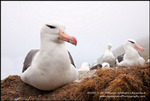
In my next Falklands post, we will discuss the largest seabird that breeds on the Falklands the Black-browed Albatross.

Wednesday
Jul062011

Learning Sessions - Photography & Photoshop Post Processing 

I have been asked by many new photographers why I don't offer instruction in photographic techniques and principles.  For whatever reason, I have never managed to get around to putting together a basic short course that I believed warranted attention. 

I finally have taken the time to put together a course which is to be offered on a 1:1 basis or in very small groups. You can read about the two learning sessions by clicking the LEARNING tab in the menu.

  • Photographic Techniques & Skills
  • Post Processing Techniques,  Image Management & Skills

Each course is thorough in its content and is designed to make you a better photographer, either from behind the camera or computer screen.

Tuesday
Jun282011

Rhinopias - Diving The Wallace Line, Western Indonesia

There are parts of Indonesia that are special places, especially those that fall along what has been named by biologists as the Wallace Line.  This imaginary line (actually it is defined geologically) separates the ecozones between Asia and broadly-speaking Australia.  Along the line the biodiversity is exceptionally high and there are many rare, uncommon and distinctly unusual species. 

In April 2011, I spent a tad over 3 weeks diving several areas along the Wallace Line n search of some of these species.

LEFT: A purple phase Weedy Scorpionfish (Rhinopias frondosa) although brighly coloured is highly camouflaged amongst the surrounding coral rubble.

The water will be cold - I had been told....

I’d been warned that the water would be cold.  Despite the warning, I still gasped as I fell from the boat into the 21 degree water.  Considering I was diving in Indonesia, which straddles the equator, it was surprising to be almost suffering heat exhaustion on the surface and then to be exhibiting the mild symptoms of hyperthermia 10 minutes later.

LEFT: A purple phase Weedy Scorpionfish (Rhinopias frondosa).  It's interesting that many fish cannot see colour, but can define tones.  So, why is Rhinopias coloured so brightly.

I was diving in the region of Alor and Flores in search of unusual fish and nudibranches.  In particular I was hunting (photographically speaking) a relatively uncommon and rare fish with the spectacular name of Rhinopias.  I’d only seen fish belonging to this genus a couple of times when diving in Papua New Guinea, and on these dives I was unfortunate to not have my underwater camera with me.

Rhinopias sp. - An Unusual Fish Species

Rhinopias means “long nasal septum”  and comes from the Greek and Latin translation.  All species belonging to this genus have this same characteristic -  a long slender snout leading to a huge cavernous mouth.  What separates the different species is subtle characteristics such as the type and number of appendages, and size of pectoral fins, and the locations in which the fish is found.  Colour and size, which can be controlled by food supply and environment. have no direct relationship to each species.

 Cold Water & Muck Diving

The water was mind-numbing cold and despite wearing a full wetsuit, I found it increasingly difficult to maintain my vigilance searching along the muddy bottom for the prized fish.  This area was not a beautiful reef in  brilliantly clear sunlit water, but rather rocky substrate adjacent to a village populated by a few thousand Indonesians living an almost “hand to mouth“ traditional lifestyle.  The visibility was limiting due to silt and debris entrained within the water column, and the bottom strewn with silt-covered boulders.  This was one of the favoured habitats Rhinopias; this style of diving is what has been named by the diving community as “muck diving”.

LEFT (2 images):  A Paddle-flap Scorpionfish (Rhinopias eschmeyeri).  Note the different colour hue and the lack of white "highlighted" eyebrows to that of the same species in upper photograph; variation is common amougst Rhinopias sp.

Muck diving came of age after intrepid divers decided to begin to explore the not so often dived areas adjacent to bridges, rivers, marshes, wetlands and villages.  You won’t the usual reef dwellers here, but you are liable to find the unusual, the ugly, and the strange.  You may also come across the juvenile forms of many of the more common reef species, as these backwaters are a safer habitat for small fry.

To add to discomfort a chilly thermocline had developed at a depth of 25 meters and I was reluctant to sink into the shimmering layer as the water here was colder than the warmer water above.  The shimmering water meandered its way across the rocky slope enveloping me for a minute or so before moving deeper; it was like going from a warm bath to a bath with floating ice cubes – then back again.

Why Are Rhinopias Special

Rhinopias is a genus of scorpionfish (Scorpanidadae) containing six species, and like other scorpionfish, utilise camouflage to blend in with their surroundings;  I’ve always found it odd that a bright red, pink, yellow or purple fish can be almost invisible as you swim over it.  Even when photographing the Rhinopias, I often find myself searching for the animal after swimming off a distance before making another run to take photographs - so good is nature to have provided such as tantalizingly beautiful veil of deception.

LEFT: A yellow phase Weedy Scorpionfish (Rhinopias frondosa) showing detail of the lure appendage over the cavernous mouth.

Rhinopias are rare fish, and sometimes appear in the aquarium trade, where they fetch high prices.  They are lie and wait predators and generally are not fast swimmers.  Their camouflage is unusual as the fish are brightly coloured over an often dappled base colour.  This bright colouring however, doesn’t appear to offer any resistance to their reputation of being exceptionally dangerous bottom dwellers.  To add to their concealment, are variously sized appendages which assist to breakup the visual outline of the fish and help disguise the large lips and mouth.

The appendage above the head of Rhinopias is used a lure and is often waved about like a small worm on a hook.  Any interested passer by, stopping to investigate the waving appendage is quickly consumed as the fish opens its mouth and lunges quickly forward.  The movement and opening of the mouth is enough to create a vacuum which sucks into the mouth any unsuspecting small fry.

Photographing Rhinopias

The most difficult part of photographing Rhinopias is actually finding the fish.  Because this species often resides in silty and muddy environments, ensuring that the water remains as clean as possible is a photographer’s first task.  Inappropriate fin movement and hand placement can completely envelope you and the fish with silt removing any opportunity you may have had to produce a good photograph.  Therefore, good diving practices are required and neutral buoyancy must be maintained at all times; a somewhat trying task when swimming in a current.

Visibility was quite poor during this particular dive and despite being slack tide, the tidal current carried  copious volumes of silt and debris from a the mouth of a nearby stream.  Backscatter was a major concern and to minimise this backscatter (seen as bright spots in a photograph) accurate strobe placement is essential.  I wanted the light from the twin strobes to just touch the fish and not illuminate the background water and entrained silt. 

The photographs were taken with a Canon 5D MK2 in a Subal housing.  The camera and strobes were set to manual to allow complete control over shutter speed, aperture and exposure.

Jostling With the Current

The current, heavy camera housing and twin strobes conspired against me as I jostled for a suitable shooting position.  Several times I had to float past the fish, turn and swim back up-current for another run, because I was not in the correct shooting position.  Everything from strobe placement, shooting angle, aperture and exposure had to be pre-visualised so as to acquire a successful photograph. 

The prize photograph is a Rhinopias lunging with its mouth open, but despite repeated attempts none of the fish I observed appeared interested in doing this for the camera, despite being offered a few tender morsels as a reward!

In my next post dealing with this visit to Indonesia, we’ll look at some of the other bizarre creatures encountered whilst diving: crocodile eels, rare nudibranchs, colourful morays and frogfish. 

If you have liked this post, why not let me know in the comment field below.