<?xml version="1.0" encoding="UTF-8"?>
<!--Generated by Squarespace V5 Site Server v5.13.166 (http://www.squarespace.com) on Thu, 20 Jun 2013 11:58:18 GMT--><feed xmlns="http://www.w3.org/2005/Atom" xmlns:dc="http://purl.org/dc/elements/1.1/"><title>Anaspides Photography - Iain D. Williams</title><subtitle>Anaspides Photography - Iain D. Williams</subtitle><id>http://www.anaspidesphotography-blog.com/journal/</id><link rel="alternate" type="application/xhtml+xml" href="http://www.anaspidesphotography-blog.com/journal/"/><link rel="self" type="application/atom+xml" href="http://www.anaspidesphotography-blog.com/journal/atom.xml"/><updated>2013-06-14T05:17:16Z</updated><generator uri="http://five.squarespace.com/" version="Squarespace V5 Site Server v5.13.166 (http://www.squarespace.com)">Squarespace</generator><entry><title>Shingleback Crossing - Stop and Lend a Hand</title><category term="Conservation"/><category term="Conservation"/><category term="Pinecone Lizard"/><category term="Reptiles"/><category term="Shingleback Lizard"/><category term="South Australia"/><category term="Tiliqua rugosa"/><id>http://www.anaspidesphotography-blog.com/journal/2013/6/14/shingleback-crossing-stop-and-lend-a-hand.html</id><link rel="alternate" type="text/html" href="http://www.anaspidesphotography-blog.com/journal/2013/6/14/shingleback-crossing-stop-and-lend-a-hand.html"/><author><name>Iain Williams</name></author><published>2013-06-14T05:14:39Z</published><updated>2013-06-14T05:14:39Z</updated><content type="html" xml:lang="en-US"><![CDATA[<p style="text-align: justify;"><span class="thumbnail-image-float-left ssNonEditable"><span><a href="javascript:showFullImage('/display/ShowImage?imageUrl=%2Fstorage%2Fpost-images%2F2013%2Fmay-pinecone-lizard-road-crossing%2F2346%252023%2520Sep%25202012%2520.jpg%3F__SQUARESPACE_CACHEVERSION%3D1370312910749',750,500);"><img src="http://www.anaspidesphotography-blog.com/storage/thumbnails/3723462-22816634-thumbnail.jpg?__SQUARESPACE_CACHEVERSION=1370312913915" alt="" /></a></span></span>Road kill is always on my mind when I travel in Australia.&nbsp; More often than not, I see dead or maimed animals along the road verge; the by-product of modern, high speed motor transport.&nbsp; The further one travels away from the city limits the more prolific road kill can become. &nbsp;</p>
<p style="text-align: justify;"><strong>LEFT:</strong>&nbsp; A shingleback lizard is given a helping hand to cross a busy highway in South Australia (click for larger view).</p>
<p style="text-align: justify;">On a recent trip to South Australia, the time taken to travel between points was longer than normal.&nbsp; The culprit that was slowing my travel was a relatively small slow moving animal protected by a heavy armour of interlocking&nbsp; pine cone-looking scales; it was the Shingleback Lizard (<em>Tiliqua rugosa</em>), often referred to as the pinecone or stumpy-tailed lizard. &nbsp;</p>
<p style="text-align: justify;">It appeared that every time I gathered driving speed, I&rsquo;d witness yet another <em>"pinecone"</em> crossing the road.&nbsp; Sometimes they would amble quite briskly across the centre-line, only to stop and raise their head, sensing the vibrations of an approaching vehicle, before doubling back into the direct line of the vehicle.&nbsp; I was stopping several times within a few kilometres, to dismount and rescue these ancient-looking dinosaurian-looking reptiles.</p>
<p style="text-align: justify;"><strong><span style="color: #990000;" lang="EN">Brief Natural History<br /></span></strong></p>
<p style="text-align: justify;">Shingleback Lizards, the largest lizard of the Skink family, live alone for most of the year; however, between September and November reunite as monogamous pairs.&nbsp; Shinglebacks are often seen crossing roads in pairs, with the male following the female; the same pairs may unite every year during the mating season.&nbsp; With the life expectancy of a shingleback reaching approximately 20 years and the fact that they are monogamous, it&rsquo;s important that individual lizards are not squashed unnecessarily into the bitumen by uncaring motorists.</p>
<p style="text-align: justify;"><strong><span style="color: #990000;" lang="EN">Unique Facts - say no to<em>"SEX"</em> with your brother</span></strong></p>
<p style="text-align: justify;">One very interesting aspect of shingleback reproduction is the ability of the lizards to discriminate between kin and non-kin, even after being separated from their mothers after birth.&nbsp; This observation has been scientifically tested by observing that they preferentially direct attention and tongue flicks to related over non-related individuals (Main &amp; Bull, 1996).&nbsp; The mechanism for this unusual ability is unknown, but probably involves olfactory cues.&nbsp; Whatever the mechanism, not reproducing with your &ldquo;brother or sister&rdquo; has obvious genetic benefits and cannot be dismissed.</p>
<p style="text-align: justify;"><span class="thumbnail-image-float-left ssNonEditable"><span><a href="javascript:showFullImage('/display/ShowImage?imageUrl=%2Fstorage%2Fpost-images%2F2013%2Fmay-pinecone-lizard-road-crossing%2F2357%252023%2520Sep%25202012%2520.jpg%3F__SQUARESPACE_CACHEVERSION%3D1370313009210',567,850);"><img src="http://www.anaspidesphotography-blog.com/storage/thumbnails/3723462-22816635-thumbnail.jpg?__SQUARESPACE_CACHEVERSION=1370313009211" alt="" /></a></span></span>Reptiles are ectothermic meaning they derive their body warmth directly from the environment.&nbsp; This is one reason why you never see reptiles during the winter months or on cold overcast days.&nbsp; It's also another reason that you often see reptiles sunning themselves on the road verge; the bitumen is warm.&nbsp; To aid in warming itself, the shingleback has the ability to arc and flatten its body extending its scales so that they present a greater surface area towards the sun.&nbsp; An added benefit to this solar warming is defence; flattening itself the shingleback can appear larger in size.&nbsp; The posture and size also mimics a highly venomous snake called the death adder.</p>
<p style="text-align: justify;"><strong>LEFT:</strong> A meeting and mutual respect; a shingleback lizard (<em>Tiliqua rugosa</em>) is carefully carried across the highway (click for larger view).</p>
<p style="text-align: justify;"><strong><span style="color: #990000;" lang="EN">Foraging Strategies and Navigation</span></strong></p>
<p style="text-align: justify;">Foraging strategies change throughout the year among sexes.&nbsp; During the two months before mating males use a time-maximization strategy, while females use an energy- maximization strategy.&nbsp; During mating when lizards are paired, the male eats significantly less than the female whose eating habits do not alter.&nbsp; During this time the male maintains a distance of a few centimeters behind the female.&nbsp; This behavior when paired, presumably suggests that males are on the alert for rival males.&nbsp; Bull &amp; Pamula (1998) discovered that females can detect danger far more quickly when paired than when alone, and when paired the female earlier when the male is feeding.&nbsp; They suggested this behavior maybe an adaptation for identifying large predators, such as dingoes, feral cats and wedge-tailed eagles when plant food is only available at exposed locations.</p>
<p style="text-align: justify;">A study by Freake (2001) found that the lizard can use celestial cues as a navigational strategy to return to its home range. It detects these cues using its parietal eye, perhaps functioning as a celestial compass. &nbsp;</p>
<p style="text-align: justify;"><strong><span style="color: #990000;" lang="EN">Not a Klutz</span></strong></p>
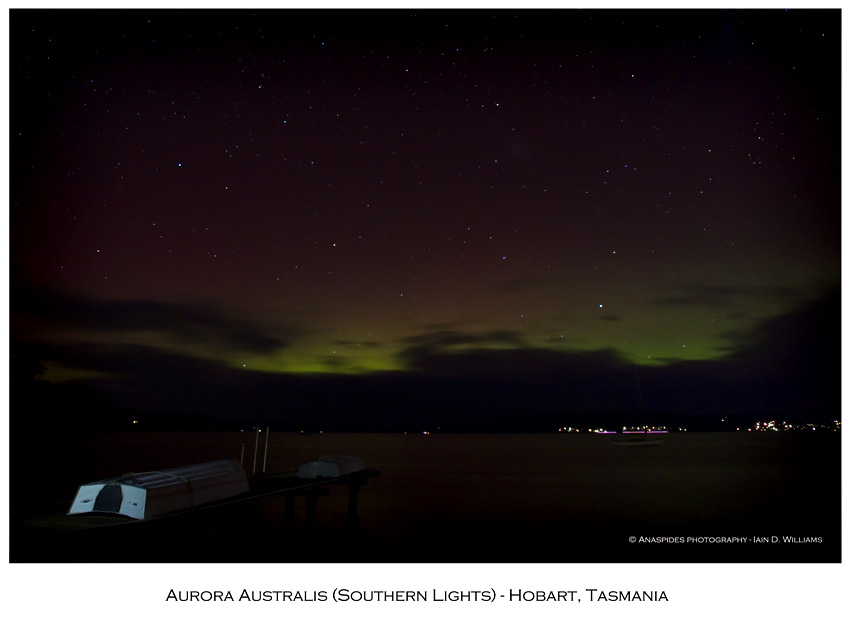
<p style="text-align: justify;">If you have read this far, you&rsquo;ll realize that the Shingleback is not just a slow-moving armoured klutz, but a marvel of evolutionary design.&nbsp; Therefore, the next time you see a <em>"pinecone"</em> crossing the road, give way to the shingleback.&nbsp; Better still, stop your vehicle and give the lizard a helping hand.</p>]]></content></entry><entry><title>Aurora Australis (Southern Lights) Tasmania</title><category term="Aurora Australis"/><category term="Auroras"/><category term="Australia"/><category term="Southern Lights"/><category term="Tasmania"/><id>http://www.anaspidesphotography-blog.com/journal/2013/6/2/aurora-australis-southern-lights-tasmania.html</id><link rel="alternate" type="text/html" href="http://www.anaspidesphotography-blog.com/journal/2013/6/2/aurora-australis-southern-lights-tasmania.html"/><author><name>Iain Williams</name></author><published>2013-06-02T12:36:20Z</published><updated>2013-06-02T12:36:20Z</updated><content type="html" xml:lang="en-US"><![CDATA[<p style="text-align: justify;"><span class="thumbnail-image-float-left ssNonEditable"><span><a href="javascript:showFullImage('/display/ShowImage?imageUrl=%2Fstorage%2Fthumbnails%2F3723462-22821161-thumbnail.jpg%3F__SQUARESPACE_CACHEVERSION%3D1370176289765',311,450);"><img src="http://www.anaspidesphotography-blog.com/storage/thumbnails/3723462-22821162-thumbnail.jpg?__SQUARESPACE_CACHEVERSION=1370176289766" alt="" /></a></span></span>Saturday evening there was the chance that an Aurora maybe visible from high latitudes due to a coronal mass ejection (CME).&nbsp; A CME is an ejection of a large amount of solar  plasma (mostly protons and electrons) and magnetic fields from the Sun. Most CMEs are ejected into space nowhere near the Earth. Those that do impact Earth can disturb the Earth's magnetic field and  lead to a subsequent disruption of the ionosphere which is observed as an Aurora.</p>
<p style="text-align: justify;"><strong>LEFT:</strong>&nbsp; Image showing coronal mass ejections from the sun (copyright Rollin Bishop)</p>
<p style="text-align: justify;">In the southern hemisphere an Aurora is called the Aurora Australis (Southern Lights) and in the northern hemisphere the same event is called the Aurora Borealis (Northern Lights).</p>
<p>Although this Aurora wasn't particularly intense, it was still worth the short drive from Hobart.<span class="full-image-block ssNonEditable"><span><img src="http://www.anaspidesphotography-blog.com/storage/post-images/2013/june-aurora/aurora-1_USM.jpg?__SQUARESPACE_CACHEVERSION=1370180184277" alt="" /></span></span></p>]]></content></entry><entry><title>Wildlife Conservation &amp; Anti Pouching (talk) - IAPF</title><category term="Conservation"/><category term="IAPF"/><category term="International Anti-Poaching Foundation"/><category term="Sixth Extinction Event"/><category term="Wildlife Conservation"/><id>http://www.anaspidesphotography-blog.com/journal/2013/5/23/wildlife-conservation-anti-pouching-talk-iapf.html</id><link rel="alternate" type="text/html" href="http://www.anaspidesphotography-blog.com/journal/2013/5/23/wildlife-conservation-anti-pouching-talk-iapf.html"/><author><name>Iain Williams</name></author><published>2013-05-23T10:01:26Z</published><updated>2013-05-23T10:01:26Z</updated><content type="html" xml:lang="en-US"><![CDATA[<p>The talk below was held on May 4, 2013 at the Sydney Opera House in Australia to a sold out audience.&nbsp; &nbsp;</p>
<p>Damien Mander is an ex Special Forces (Special Air Service/SAS) operative who, after had a successful career in the military, made a personal decision to preserve wildlife and end the horrific poaching that is decimating Africa&rsquo;s wildlife.&nbsp;&nbsp; Damien founded the International Anti-Poaching Foundation (IAPF) based in Zimbabwe.</p>
<p>Damien discusses the urgent need for conservation on a global basis.&nbsp; He concludes his talk with an interesting question, one which I believe all of us who photograph animals need to ask ourselves.</p>
<p>I strongly recommend you listening to Damien in the embedded video below.</p>
<p>&nbsp;<iframe width="640" height="360" src="http://www.youtube.com/embed/9FCsyK4aRXQ?feature=player_detailpage" frameborder="0" allowfullscreen></iframe></p>]]></content></entry><entry><title>Decision To Not Use Social Media</title><category term="Apps"/><category term="Google+"/><category term="Social Media"/><category term="Social Media"/><category term="Time Wasters"/><category term="Twitter"/><category term="facebook"/><id>http://www.anaspidesphotography-blog.com/journal/2013/5/17/decision-to-not-use-social-media.html</id><link rel="alternate" type="text/html" href="http://www.anaspidesphotography-blog.com/journal/2013/5/17/decision-to-not-use-social-media.html"/><author><name>Iain Williams</name></author><published>2013-05-17T04:41:08Z</published><updated>2013-05-17T04:41:08Z</updated><content type="html" xml:lang="en-US"><![CDATA[<p><strong><span class="full-image-float-left ssNonEditable"><span><img src="http://www.anaspidesphotography-blog.com/storage/post-images/2013/january-social-media/Social-Media-Marketing.jpg?__SQUARESPACE_CACHEVERSION=1358318731372" alt="" /></span></span>Web Presence</strong></p>
<p style="text-align: justify;">Many  photographers have flocked to social mediums such as Facebook, Twitter  and Google + to ply their wares and expertise.&nbsp; I have shunned these  platforms for the most part, believing that the time spent posting  to these mediums can be used more beneficially elsewhere.&nbsp; I continue to  share this belief and if blog hits are anything to go by (around 3500 per week excuding robots and web crawlers), the numbers  support my decision.</p>
<p style="text-align: justify;">It appears that many individuals determine their success or the success of others based upon how many followers they have on Facebook, Twitter or Google +, rather than looking at the business and examining how much revenue is generated as a direct result of social media.&nbsp; The last time I looked, most "followers" using Twitter and Google + were other photographers "sproating" how good they were or where they are going to next, and not potential buyers of your products or services.</p>
<p style="text-align: justify;">Individuals often spend too much time engrossed in updating social media and forget that their time equates to money.&nbsp;</p>
<p style="text-align: justify;">I'm not suggesting that social media doesn't have a purpose or value, but it should <em><strong>not</strong></em> be used to determine a business's and individual's success or professional ability.</p>]]></content></entry><entry><title>Fossil Flora - Photographing Plant Fossils In Situ - Part 3</title><category term="Central Australia"/><category term="Photograhic Technique"/><category term="Photographic Techniques and Skills"/><category term="Photographing Fossils"/><category term="Plant Fossils"/><category term="Project - Fossils"/><category term="Silcrete Fossils"/><category term="Tertiary Period"/><category term="Tertiary Plant Fossils"/><id>http://www.anaspidesphotography-blog.com/journal/2013/5/3/fossil-flora-photographing-plant-fossils-in-situ-part-3.html</id><link rel="alternate" type="text/html" href="http://www.anaspidesphotography-blog.com/journal/2013/5/3/fossil-flora-photographing-plant-fossils-in-situ-part-3.html"/><author><name>Iain Williams</name></author><published>2013-05-03T10:41:01Z</published><updated>2013-05-03T10:41:01Z</updated><content type="html" xml:lang="en-US"><![CDATA[<p style="text-align: justify;">For the most part nature photographers strive to capture their subjects in the early morning and late afternoon when the light is lower to the horizon.&nbsp; During this &ldquo;golden hour&rdquo; the colours are highly saturated and are much more pleasing to the eye than if the photograph was taken during the middle part of the day in full sun.&nbsp; However, photographing fossils in-situ is a little different as often there was a few hours hiking to find the fossils and it wasn&rsquo;t possible to wait until early morning or later afternoon to take the photograph.</p>
<p style="text-align: justify;"><strong>Techniques</strong></p>
<p style="text-align: justify;">It's important to realize that photographing fossils is identical to photographing anything else - there are no set rules - only guidelines.&nbsp; Use your imagination and the equipment you have on hand.&nbsp; The process to photograph fossils in-situ is nothing magical; however,  there are a few techniques that will improve the photographs markedly.</p>
<ul>
<li>Always use a quality tripod and ball head that when locked down, is tight and does not move.&nbsp; A tripod that allows the ability of the head to be maneuvered to odd positions is a distinct advantage when photographing something that cannot be moved and is probably located in a relatively inaccessible location (rock crevice, overhand, etc).</li>
</ul>
<ul>
<li>Fossil leaf photography is essential macro photography; therefore, use quality lenses and if possible a full frame camera.&nbsp; Ensure you use a timer release as many of your images will be taken at slow shutter speeds to ensure adequate depth of field. &nbsp;</li>
</ul>
<ul>
<li>Use a solid board to mask your subject from the wind.&nbsp; The wind is quite normal in mid latitude arid areas and can cause camera movement if shooting at a slow shutter speed.</li>
</ul>
<ul>
<li>Use a reflector board and largish diffuser to remove stark contrasting lines that may otherwise ruin your image if you are shooting during the middle parts of the day. &nbsp;</li>
</ul>
<ul>
<li>Make use a fill flash to add, remove or change the location of shadows.&nbsp; Use a wireless flash head (or similar) to avoid any camera movement that maybe caused by the flash head or cord moving.&nbsp; A remote head also allows you to position the flash (s) at suitable distances and at odd angles to your subject. &nbsp;</li>
</ul>
<ul>
<li>Do not use ETTL, but use M (manual) to determine the exposure setting for the flash.&nbsp; You do not want a 100% flash photograph, but an image that was taken with a subtle amount of fill flash.</li>
</ul>
<ul>
<li>Try to use a diffuser with your flash.&nbsp; I&rsquo;m not discussing the small &ldquo;clip on&rdquo; diffusers but, a largish diffuser that can be held at varying distances from your flash head.&nbsp; A diffuser will lower the starkness of the light emitted from the flash.&nbsp; Using a flash as a fill light will enhance the light that may otherwise cause an object in plan-view to appear flat and uninteresting.</li>
</ul>
<ul>
<li>Be aware of the colour of your surrounding environment; central Australia is predominately red (from iron oxides) and photographs taken will inadvertently take on a reddish colour cast. &nbsp;</li>
</ul>
<ul>
<li>Ensure you white balance your images appropriately.&nbsp; Although this can be done in post processing, I prefer to take my time and white balance the images in the field; after all, the fossils are not going anywhere in a hurry&hellip;&nbsp; I use a white balance card.</li>
</ul>
<ul>
<li>Depending upon what you are attempting to achieve, position the camera lenses at the appropriate angle to the subject.&nbsp; For instance, if you wish to create a scientific photograph in which the complete fossil is shown, position your camera and lenses so that the lens plane is parallel to the subject.&nbsp; This will ensure that the fossil (in plan-view) will be in focus, even if using minimal depth of field.</li>
</ul>
<ul>
<li>If your photographs look flat and lack texture because of the bright light from shooting in the middle of the day, try spraying some water from&nbsp; small squeeze bottle onto the fossil.&nbsp; Often, a little water will make the colours and texture of an otherwise flat object pop.</li>
</ul>
<p>The <strong>below images</strong> are case in point.&nbsp; The photograph on the left was taken without a diffuser or fill flash while that on the right was taken with a diffuser, soft fill flash and a quick spray of water on the rock.&nbsp; Conditions were full sun.&nbsp; Note the subtle differences in colour, texture and shadow.&nbsp; Click image for larger view.</p>
<p style="text-align: justify;"><strong><span class="thumbnail-image-block ssNonEditable"><span><a href="javascript:showFullImage('/display/ShowImage?imageUrl=%2Fstorage%2Fpost-images%2F2013%2Fapril-stuart-creek-bp-3%2Ffossil-technique-montage-copyright.jpg%3F__SQUARESPACE_CACHEVERSION%3D1367576478789',683,1024);"><img src="http://www.anaspidesphotography-blog.com/storage/thumbnails/3723462-22546242-thumbnail.jpg?__SQUARESPACE_CACHEVERSION=1367576478790" alt="" /></a></span></span>Composition</strong></p>
<p style="text-align: justify;">Fossil photography is often done for scientific purposes; therefore, the photographic layout must comply with certain guidelines such as the inclusion of a ruler or known size object to provide a scale.&nbsp; The subject should also be photographed completely flat with all aspects of the fossil in focus.</p>
<p style="text-align: justify;">However, if you&rsquo;re not bound by these guidelines, composition is very important.&nbsp; Position the fossil so it&rsquo;s at an angle rather than vertical or horizontal; using angles gives your subject more visual power.&nbsp; Try using minimal depth of field to add illusion to your image or attempt to place something in the image which provides scale. &nbsp;</p>
<p style="text-align: justify;">Looking at <strong>three images below</strong>, you will note the leaf in the right hand photo is at an angle forming a triangle in the image, while the center image shows part of the landscape surrounding the fossil and places the fossils in context with its surrounding environment; this creates interest.&nbsp; Finally the Eucalyptus leaf I have positioned vertically with the apex of the leaf pointing downwards.&nbsp; The reason for this composition is that it replicates the way extant (present day) eucalyptus leaves appear on trees &ndash; pointing downwards.&nbsp;</p>
<p style="text-align: justify;">If you navigate to the <a title="second journal post" href="http://www.anaspidesphotography-blog.com/journal/2013/3/10/fossil-flora-silcrete-plant-fossils-evidence-for-climate-cha.html" target="_blank"><strong>second journal post</strong></a> on this subject you will observe that I&rsquo;ve also used minimal depth of field on one of the leaves to provide illusion.</p>
<p><span class="thumbnail-image-block ssNonEditable"><span><a href="javascript:showFullImage('/display/ShowImage?imageUrl=%2Fstorage%2Fpost-images%2F2013%2Fapril-stuart-creek-bp-3%2Ftemplate_fossils_composition.jpg%3F__SQUARESPACE_CACHEVERSION%3D1367576526695',512,1024);"><img src="http://www.anaspidesphotography-blog.com/storage/thumbnails/3723462-22602078-thumbnail.jpg?__SQUARESPACE_CACHEVERSION=1367576526695" alt="" /></a></span></span></p>
<p style="text-align: justify;"><strong>Problems or Challenges</strong></p>
<p style="text-align: justify;">If you cater towards everything mentioned, you&rsquo;ll almost need a mule to transport your equipment.&nbsp; Carrying the gear was one of my biggest concerns on this trip.&nbsp; We were walking considerable distances for most of the day in very warm temperatures.&nbsp; Carrying the photographic equipment, food and other essential items such as map, compass, DGPS and 5 litres of water was tedious.</p>
<p style="text-align: justify;">Add to this a constant wind and bright sunny conditions, and photographing fossils became an enjoyable challenge.</p>
<p style="text-align: justify;">This is a short video I made of the trip. The reason for the relatively lengthy four wheel drive sequence is to indicate the length of time it took to reach the location.&nbsp; If your computer is not powerful, click HD to remove High Definition and view at a lower resolution.</p>
<p style="text-align: justify;"><iframe src="http://player.vimeo.com/video/65133347" width="500" height="281" frameborder="0" webkitAllowFullScreen mozallowfullscreen allowFullScreen></iframe></p>
<p>The<strong> below plate</strong> depicts a few of the fossils found and photographed in-situ.&nbsp; No fossils were removed or collected; this being an illegal activity in Australia.&nbsp; I have purposely not included the identification of each fossil.&nbsp; Click image for larger view.</p>
<p>This is the final post of three dealing with this excursion.&nbsp; To read the <a title="fossils post 1" href="http://www.anaspidesphotography-blog.com/journal/2013/1/21/fossil-flora-searching-for-photographing-fossils-to-document.html" target="_blank"><strong>first post</strong></a> and <a title="fossils post 2" href="http://www.anaspidesphotography-blog.com/journal/2013/3/10/fossil-flora-silcrete-plant-fossils-evidence-for-climate-cha.html" target="_blank"><strong>second post</strong></a> click here.</p>
<p><span class="thumbnail-image-block ssNonEditable"><span><a href="javascript:showFullImage('/display/ShowImage?imageUrl=%2Fstorage%2Fpost-images%2F2013%2Fapril-stuart-creek-bp-3%2Ffossils_template_2a.jpg%3F__SQUARESPACE_CACHEVERSION%3D1367576695582',2388,1024);"><img src="http://www.anaspidesphotography-blog.com/storage/thumbnails/3723462-22602077-thumbnail.jpg?__SQUARESPACE_CACHEVERSION=1367576695583" alt="" /></a></span></span></p>]]></content></entry><entry><title>Fossil Flora - Silcrete Plant Fossils; Evidence for Climate Change - Part Two</title><category term="Changing Environments"/><category term="Climate Change"/><category term="Deserts"/><category term="Earth Science"/><category term="Fossil Flora"/><category term="Fossils"/><category term="Geology"/><category term="Gibber Deserts"/><category term="Lake Eyre Stratigraphy"/><category term="Mud Cracks"/><category term="Plant Fossils"/><category term="Project - Fossils"/><category term="Tertiary Period"/><id>http://www.anaspidesphotography-blog.com/journal/2013/3/10/fossil-flora-silcrete-plant-fossils-evidence-for-climate-cha.html</id><link rel="alternate" type="text/html" href="http://www.anaspidesphotography-blog.com/journal/2013/3/10/fossil-flora-silcrete-plant-fossils-evidence-for-climate-cha.html"/><author><name>Iain Williams</name></author><published>2013-03-10T09:58:10Z</published><updated>2013-03-10T09:58:10Z</updated><content type="html" xml:lang="en-US"><![CDATA[<p style="text-align: justify;">Hartley, 1967 stated <em>&ldquo;The past is a foreign country&rdquo;</em></p>
<p style="text-align: justify;">The validity of this statement becomes readily apparent looking across the vista of breakaways, dry sandy terrain, silcrete-covered ridges and dry gibber desert.&nbsp; A stark contrast exists between the present day environment and the evidence presented by fossil flora of the very different conditions that prevailed here, when the fossils were deposited.&nbsp; What had previously been a wet, lush, and green environment that supported a complex mosaic of tropical and temperate rainforest, is now devoid of all but the most resilient vegetation.</p>
<p style="text-align: justify;">The content of this post, because of its scientific nature is rather specialised, however, I have attempted to succinctly explain the region&rsquo;s local geology and provide evidence to how the fossils found in the area can be used to interpret climatic change.&nbsp; To view an image larger, double click the image.</p>
<p style="text-align: justify;"><strong><span class="thumbnail-image-float-left ssNonEditable"><span><a href="javascript:showFullImage('/display/ShowImage?imageUrl=%2Fstorage%2Fpost-images%2F2013%2Ffebruary-stuart-creek-bp-2%2Fgibber%2520deserts%2520and%2520washaways%25202.JPG%3F__SQUARESPACE_CACHEVERSION%3D1362886302017',467,800);"><img src="http://www.anaspidesphotography-blog.com/storage/thumbnails/3723462-22125317-thumbnail.jpg?__SQUARESPACE_CACHEVERSION=1362886304169" alt="" /></a></span></span>Geology</strong></p>
<p style="text-align: justify;">The region&rsquo;s geology has been poorly studied, despite there being considerable interest because of the record of surface environments in the Eyre basin over the past 40 million years, and the famous silcrete floras and mammalian megafauna. &nbsp;</p>
<p style="text-align: justify;"><strong>LEFT:</strong>&nbsp; A satellite view of the region (<em>courtesy Google Maps</em>) clearly showing the drainage lines (green), gibber plains (light brown) and breakaways (dark brown).</p>
<p style="text-align: justify;">The geology is complex, in part because of the number of stratigraphic units involved and the interrelationship between lacustrine, fluvial, and aeolian sediments.&nbsp; It&rsquo;s this interrelationship and the variable development of duricrusts which has recently propelled the region&rsquo;s interest, as these environments provide good scientific analogues for the surface of Mars.</p>
<p style="text-align: justify;">The basement rock is comprised of marine deposited shale laid down during the Cretaceous Period when much of what is now inland Australia was covered in seawater.&nbsp; The break-up of Gondwanaland and resultant rearrangement of tectonic plates gently deformed and duricrusted this shale, named the Bulldog Shale, to form the gibber plain uplands of the Stoney Desert.&nbsp; The breakaways, prominent sentinels in today&rsquo;s environment, are comprised of fluvial and lacustrine-derived sediments deposited during the Upper Triassic and Lower Tertiary, and were formed by erosion from several ephemeral streams including Coopers Creek.</p>
<p style="text-align: justify;"><strong>Sedimentology and Palaeoenvironments&nbsp; &nbsp;</strong></p>
<p style="text-align: justify;">I&rsquo;ve attempted to provide a short introduction to the sedimentary units involved in the formation of the palaeochannel in which the fossils have been deposited. This interpretation is quite broad in content and further study and work needs to be done to accurately assign dates to the various stratigraphic units. &nbsp;</p>
<p style="text-align: justify;"><strong><span class="thumbnail-image-float-left ssNonEditable"><span><a href="javascript:showFullImage('/display/ShowImage?imageUrl=%2Fstorage%2Fpost-images%2F2013%2Ffebruary-stuart-creek-bp-2%2F0571%252018%2520Sep%25202012%2520.jpg%3F__SQUARESPACE_CACHEVERSION%3D1362886121204',750,500);"><img src="http://www.anaspidesphotography-blog.com/storage/thumbnails/3723462-22141419-thumbnail.jpg?__SQUARESPACE_CACHEVERSION=1362886122933" alt="" /></a></span></span>Palaeoenvironment</strong></p>
<p style="text-align: justify;">The nature of the palaenvironment is well understood; a fluvial system with well-established oxbow lakes and shallow lakes surrounded by a mosaic of riparian tropical to temperate rainforest in a warm semi-tropical climate.</p>
<p style="text-align: justify;"><strong>LEFT:&nbsp;</strong> Indistinct to the untrained eye, this sandstone rock exhibits tell-tai sedimentary structures which indicate that the region was once covered in water.&nbsp; The ripple marks can be used, amougst ither things, to interpreete water depth and current direction.</p>
<p style="text-align: justify;">During the mid-Tertiary, the environment began to experience seasonality with fluctuating watertable levels; increased periods of semi-aridity began to alter the rainforest mosaic until species survived only around permanent water channels and lakes.&nbsp; Eventually, as Australia and Antarctica separated and Australia moved north, aridity became more widespread and taxa became locally extinct.</p>
<p style="text-align: justify;"><strong>The Watchie Sandstone Unit</strong></p>
<p style="text-align: justify;">The Watchie Sandstone is a lacustrine sequence comprising; in upwards succession, a local channel-sand facies and widespread lag deposits, a transgressive fine-grained lacustrine facies and regressive strandline deposits with a wavebase lag. &nbsp;</p>
<p style="text-align: justify;"><span class="thumbnail-image-float-left ssNonEditable"><span><a href="javascript:showFullImage('/display/ShowImage?imageUrl=%2Fstorage%2Fpost-images%2F2013%2Ffebruary-stuart-creek-bp-2%2F0600%252018%2520Sep%25202012%2520.jpg%3F__SQUARESPACE_CACHEVERSION%3D1362888011775',750,500);"><img src="http://www.anaspidesphotography-blog.com/storage/thumbnails/3723462-22141420-thumbnail.jpg?__SQUARESPACE_CACHEVERSION=1362888014915" alt="" /></a></span></span>Lag deposits indicate a low-gradient surface and strandlines incorporating pedogenic silcrete clast provide evidence of former soil horizons.&nbsp;&nbsp;&nbsp; The palaeocurrent evidence is consistent with longshore processes and bar accretion onto a foreshore and larger bedforms indicate storm events.&nbsp; Ridges have formed only along the eastern shoreline, indicating a strong westerly airstream and silicification and ferruginisation alternated during lacustrine regression. &nbsp;</p>
<p style="text-align: justify;">Insects (including ants and termites) lived in developing soil profiles and rhizonodules indicate that plants grew on these soils.&nbsp; &nbsp;</p>
<p style="text-align: justify;"><strong>The Willalinchina Sandstone Unit</strong></p>
<p style="text-align: justify;">This unit was deposited in a fluvial channel environment and is interpreted as a broad, shallow meandering to braided channel system which abuts a floodplain to a lacustrine palaeoenvironment.&nbsp; Storm and associated flood events have also deposited bar, levee and floodplain deposits which interfinger with fluvial-derived sediments.&nbsp; &nbsp;</p>
<p style="text-align: justify;"><strong>LEFT:</strong>&nbsp; Partly eroded to show depth of the deposit, the structures clearly are indicative of sequential mud cracks that provide evidence of a drying environment.</p>
<p style="text-align: justify;">Field observations support this interpretation:&nbsp; A thin lens of basal conglomerate has been overlain by several meters of cross-bedded fine to medium-grained sandstone containing minor <span class="thumbnail-image-float-left ssNonEditable"><span><a href="javascript:showFullImage('/display/ShowImage?imageUrl=%2Fstorage%2Fpost-images%2F2013%2Ffebruary-stuart-creek-bp-2%2F0140%252015%2520Sep%25202012%2520.jpg%3F__SQUARESPACE_CACHEVERSION%3D1362888120756',750,500);"><img src="http://www.anaspidesphotography-blog.com/storage/thumbnails/3723462-22141414-thumbnail.jpg?__SQUARESPACE_CACHEVERSION=1362888123217" alt="" /></a></span></span>lenses of course-grained sandstone.&nbsp; Silicification, caused by alternating watertable levels, has occurred in several places.&nbsp;&nbsp; &nbsp;</p>
<p style="text-align: justify;"><strong>Silcrete and Silicification</strong></p>
<p style="text-align: justify;">Silification provides evidence of a fluctuating watertable and, in general, a marked seasonality toward aridity, which inland Australia experienced during the mid Cenozoic.&nbsp;</p>
<p style="text-align: justify;"><strong>LEFT:</strong>&nbsp;  Reed mould or ant's nest silcrete - a possible   interpretation is reed  casts or methane gas escape structures from   rotting vegetation.</p>
<p style="text-align: justify;">The silcrete is defined by closely spaced vertical structures which have been referred to in past literature as &ldquo;ants nest or reed mould silcrete&rdquo;.&nbsp; The vertical structures have been interpreted as reed casts, however, there is no evidence of organic matter found within the Willalinchina Sandstone Unit.&nbsp; A possible alternative is soft sediment deformation caused by gas escaping from rotting vegetation.&nbsp; This scenario would explain why the gas escape structures are not evident throughout the sandstone unit, but are preferentially preserved.&nbsp;</p>
<p style="text-align: justify;">Another interesting sedimentary structure preserved within the silcrete are circular mound-like features (<strong>below left</strong>) which have not been successfully interpreted. One theory suggests that the features are formed when liquid silcrete bubbled its way toward the surface, akin to how artesian water <span class="thumbnail-image-float-left ssNonEditable"><span><a href="javascript:showFullImage('/display/ShowImage?imageUrl=%2Fstorage%2Fpost-images%2F2013%2Ffebruary-stuart-creek-bp-2%2F00206%2520Stuart%2520Creek%2520030917_altered.jpg%3F__SQUARESPACE_CACHEVERSION%3D1362888573493',600,800);"><img src="http://www.anaspidesphotography-blog.com/storage/thumbnails/3723462-22141415-thumbnail.jpg?__SQUARESPACE_CACHEVERSION=1362888577269" alt="" /></a></span></span>bubbled to the surface in nearby artesian spring moulds.</p>
<p style="text-align: justify;"><strong>Silcrete</strong> is an indurated soil duricrust formed when silica is dissolved and resolidifies as a cement. It is a hard and resistant material, and though different in origin and nature, appears similar to quartzite.&nbsp; Silcrete is relatively common in inland Australia, often forming the resistant cap rock on features like breakaways.</p>
<p style="text-align: justify;"><strong>Stratigraphic Analysis and Age&nbsp;&nbsp; &nbsp;</strong></p>
<p style="text-align: justify;">Sediments  from the Palaeochannel have been placed in the Watchie and  Willalinchina Sandstone units although most of the palaeochannel area is  located within the later. &nbsp;</p>
<p style="text-align: justify;"><span class="thumbnail-image-float-left ssNonEditable"><span><a href="javascript:showFullImage('/display/ShowImage?imageUrl=%2Fstorage%2Fpost-images%2F2013%2Ffebruary-stuart-creek-bp-2%2F0107%252015%2520Sep%25202012%2520.jpg%3F__SQUARESPACE_CACHEVERSION%3D1362891468234',750,500);"><img src="http://www.anaspidesphotography-blog.com/storage/thumbnails/3723462-22141413-thumbnail.jpg?__SQUARESPACE_CACHEVERSION=1362891470169" alt="" /></a></span></span>Preliminary  palaeobotanical work suggests that the Willalinchina Sandstone  correlates with the youngest phase of the Eyre Formation in the Lake  Eyre Basin and is Eocene in age.&nbsp; The Watchie Sandstone has been  interpreted as Miocene and correlates with the Billa Kalina Basin.&nbsp;  However, recent stratigraphic analysis may indicate that the  Willalinchina Sandstone could be Miocene to Pliocene in age.&nbsp; Further  investigation needs to be made in this area before a definite date can  be attributed to the palaeochannel.&nbsp; &nbsp;</p>
<p style="text-align: justify;"><strong>Floral Record - Interpreting Climatic Change&nbsp; &nbsp;</strong></p>
<p style="text-align: justify;">The Australian Tertiary plant fossil record is very poor.&nbsp; Studies indicate that tropical to temperate rainforests occupied&nbsp; south eastern and south western Australia for much of the early-Tertiary with a contraction of these rainforest communities in the mid to late-Tertiary.&nbsp; &nbsp;</p>
<p style="text-align: justify;"><strong>LEFT:</strong> One of many example of the fossil flora found in the area.&nbsp;  The state pf preservation is amazing and identification, in some  cases, to species level is possible.</p>
<p style="text-align: justify;">The discovery of the fossil flora confirm the palaeochannel is one of the richest, most extensive Tertiary plant fossil localities in Australia, if not globally.&nbsp; &nbsp;</p>
<p style="text-align: justify;">The botanical significance of silcrete fossils may be limited because silcrete formation is notoriously difficult to interpret and date with precision; however, the presence of extensive silcrete, caused by the fluctuating watertable levels does provide evidence consistent with marked climatic seasonality that occurred in inland Australia during the Cenozoic.&nbsp; Therefore, floral assemblages could preserve evidence of the effect of climate change on the vegetation of inland Australia.</p>
<p style="text-align: justify;"><strong>Initial Analysis&nbsp;&nbsp; &nbsp;</strong></p>
<p style="text-align: justify;">Initial analysis of floral elements indicate a mosaic of plant communities dominated by sclerophyllous woodlands (<em>Eucalypt spp.</em>) and interspersed with riparian rainforests and deciduous marginal monsoon forests.&nbsp; These plants grew along the watercourses where permanent water enabled them to survive seasonal dry periods.&nbsp; &nbsp;</p>
<p style="text-align: justify;"><strong><span class="thumbnail-image-float-left ssNonEditable"><span><a href="javascript:showFullImage('/display/ShowImage?imageUrl=%2Fstorage%2Fpost-images%2F2013%2Ffebruary-stuart-creek-bp-2%2F9628%252013%2520Sep%25202012%2520.jpg%3F__SQUARESPACE_CACHEVERSION%3D1362888938071',533,800);"><img src="http://www.anaspidesphotography-blog.com/storage/thumbnails/3723462-22141423-thumbnail.jpg?__SQUARESPACE_CACHEVERSION=1362888940358" alt="" /></a></span></span>Interpretation of Fossil floras and Palaeoclimate&nbsp;&nbsp;&nbsp; </strong>&nbsp;</p>
<p style="text-align: justify;">Observational studies in tropical and temperate forests have demonstrated a direct relationship between leaf form (foliar physiognomy) and local climate.&nbsp; For example; leaf length to leaf width and stomata number and size correlate to rainfall and ambient temperature. &nbsp;</p>
<p style="text-align: justify;"><strong>LEFT:</strong>&nbsp; Ripple marks showing bifurcation of ripple crests indicate wave-formed ripples that have formed by wind blowing across shallow water.&nbsp; The ripple marks are so clear, it's difficult to realize that they were formed approximately between 24 and 5 million years before present.</p>
<p style="text-align: justify;">Mean canopy leaf size is also strongly correlated with mean annual temperature.&nbsp;&nbsp; Palaeobotanical investigations of the botanical specimens found within the palaeochannel (Willalinchina Sandstone) provides valuable information on the mid-Tertiary distribution of <em>Eucalyptus spp.</em> and other plants. &nbsp;</p>
<p style="text-align: justify;">To date 245 leaf types, 47 fruit and seed types and 2 major wood types have been identified.&nbsp;&nbsp; The sclerophyllous component (identified from linear to lanceolate leaf forms) dominated the flora and would have grown on the exposed drier plains in the more open forest areas of the floodplain. &nbsp;</p>
<p style="text-align: justify;"><span class="thumbnail-image-float-left ssNonEditable"><span><a href="javascript:showFullImage('/display/ShowImage?imageUrl=%2Fstorage%2Fpost-images%2F2013%2Ffebruary-stuart-creek-bp-2%2F0245%252016%2520Sep%25202012%2520.jpg%3F__SQUARESPACE_CACHEVERSION%3D1362907088820',750,500);"><img src="http://www.anaspidesphotography-blog.com/storage/thumbnails/3723462-22141829-thumbnail.jpg?__SQUARESPACE_CACHEVERSION=1362907094336" alt="" /></a></span></span>Many of the fossil leaves are indiscernible from extant Eucalyptus leaves and the minimal variation in leaf form suggests that Eucalyptus has existed in the area for ~15 million years.&nbsp; The ecological niche of this species, based on this information, appears to be similar to that of extant Eucalyptus.&nbsp;&nbsp; &nbsp;</p>
<p style="text-align: justify;"><strong>LEFT:</strong>&nbsp; An excellent example of <em>Banklsieaeformis praegrandi</em>.&nbsp;  If you open this image (double click) you can see the preserved  intricate patterns of the veins that have been preserved.&nbsp; The red  colour is caused by iron oxide that has percolated through the  sediments.</p>
<p style="text-align: justify;">The rainforest component of the flora grew in areas that provided a permanent water resource and are not present in the area today; their absence indicative of a changing climate and environment. As the climate became increasingly drier, these plants died out to eventually become confined to the present monsoonal and tropical rainforests of northern Australia and became locally extinct.&nbsp; &nbsp;</p>
<p style="text-align: justify;">Ancient Eucalyptus are not the only plant fossils that have been uncovered; numerous other plant species are likely to be extinct representatives of extant genera.&nbsp; As with the Eucalyptus, similarity in leaf forms between fossil leaves and extant leaves have made identification problematic and it&rsquo;s highly likely that many of these species were intermediate rainforest / sclerophyllous species sandwiched between the effects of climate change.&nbsp;&nbsp;&nbsp; &nbsp;</p>
<p style="text-align: justify;">One species that appears to have been positively identified from its deeply incised proteaceous leaf form is <em>Banklsieaeformis praegrandi.</em>&nbsp; This fossil plant has been found in low numbers within the palaeochannel and has been linked to the extant species <em>Banksia chamaephyton</em> which is restricted to a small area of heathland in Western Australia (Greenwood, 1997). &nbsp;</p>
<p style="text-align: justify;"><strong><span class="thumbnail-image-float-left ssNonEditable"><span><a href="javascript:showFullImage('/display/ShowImage?imageUrl=%2Fstorage%2Fpost-images%2F2013%2Ffebruary-stuart-creek-bp-2%2F00326%2520Stuart%2520Creek%2520030918_altered.jpg%3F__SQUARESPACE_CACHEVERSION%3D1362891748204',600,800);"><img src="http://www.anaspidesphotography-blog.com/storage/thumbnails/3723462-22141418-thumbnail.jpg?__SQUARESPACE_CACHEVERSION=1362891750989" alt="" /></a></span></span>Access &nbsp;</strong></p>
<p style="text-align: justify;">Access to this area is <span style="text-decoration: underline;">STRICTLY PROHIBITED</span> without express permission from the land owner, property station manage, and approval from an educational facility such as University or museum.&nbsp;&nbsp; Removal of fossils or collecting is <span style="text-decoration: underline;">NOT ALLOWED</span>.&nbsp;</p>
<p style="text-align: justify;"><strong>LEFT:&nbsp;</strong> Preferential erosion erodes the former land surface to leave the more harder and durable silcreted surface, in a formation called a breakaway; a term uniquely Australian.&nbsp; The breakaways can reveal the surface of an environment that often is completely changed to that of today.&nbsp; It's often difficult to grasp that approximately 70 million years ago these surfaces were the floor of a vast inland sea.</p>
<p style="text-align: justify;"><strong>Next Journal Post</strong></p>
<p style="text-align: justify;">In the  final post on this topic, we'll look at a number of photographs of the fossils and discuss the best method to photograph them in situ.</p>
<p style="text-align: justify;"><strong>References&nbsp; &nbsp;</strong></p>
<p>Krieg, G. W., Rogers, P. A., Callen, R. A., Freeman, P. J., Alley N. F. and Forbes, B. G., 1991.&nbsp; Explanatory Notes Curdimurka South Australia. 1:250,000 Geological Series Geological Survey of South Australia, Peacock Publications, pp 35 &ndash; 38.&nbsp; Rowett, A., 1997.&nbsp; Earthwatch '96.&nbsp; MESA, Journal 5, pp 27-29.&nbsp;</p>]]></content></entry><entry><title>Fossil Flora - Searching For &amp; Photographing Fossils To Document Climate Change - Part 1</title><category term="Changing Environments"/><category term="Climate Change"/><category term="Deserts"/><category term="Earth Science"/><category term="Fossils"/><category term="Geology"/><category term="Gibber Deserts"/><category term="Palaeontology"/><category term="Paleontology"/><category term="Plant Fossils"/><category term="Project - Fossils"/><category term="Tertiary Climate Change"/><id>http://www.anaspidesphotography-blog.com/journal/2013/1/21/fossil-flora-searching-for-photographing-fossils-to-document.html</id><link rel="alternate" type="text/html" href="http://www.anaspidesphotography-blog.com/journal/2013/1/21/fossil-flora-searching-for-photographing-fossils-to-document.html"/><author><name>Iain Williams</name></author><published>2013-01-21T00:19:13Z</published><updated>2013-01-21T00:19:13Z</updated><content type="html" xml:lang="en-US"><![CDATA[<p style="text-align: justify;"><span class="thumbnail-image-float-left ssNonEditable"><span><a href="javascript:showFullImage('/display/ShowImage?imageUrl=%2Fstorage%2Fpost-images%2F2013%2Fjanuary-stuart-creek-bp1%2F0515%252017%2520Sep%25202012%2520.jpg%3F__SQUARESPACE_CACHEVERSION%3D1358631802590',533,800);"><img src="http://www.anaspidesphotography-blog.com/storage/thumbnails/3723462-21656680-thumbnail.jpg?__SQUARESPACE_CACHEVERSION=1358631802591" alt="" /></a></span></span>Dead things are usually not on my list to photograph, however, I jumped at the opportunity when tasked to photograph fossils at a location in far northern South Australia.&nbsp; The fossils were deposited during the Tertiary Period (63 million years ago to 1.8 million years ago).&nbsp; During this time the environment was very different to what it is today and much of Australia was blanketed in a mantle of green with humid temperatures; a far cry from the hot dry gibber deserts and sand dunes seen today.</p>
<p style="text-align: justify;"><strong>LEFT:</strong>&nbsp; Tracks are indistinct in gibber country.</p>
<p style="text-align: justify;">The location of the fossil beds is remote, and a fully equipped four wheel drive vehicle is needed to negotiate the many small, unmarked tracks that eventually lead to the &ldquo;jumping off&rdquo; point to reach the fossils.&nbsp; From this central location, where a base camp was erected, I explored via foot a number of low lying ridges and gullies that previously had been identified as being geologically suitable for fossil preservation.</p>
<p style="text-align: justify;">This will be the first of two/three posts describing the 3 week camping trip in a relatively remote part of Australia.</p>
<p style="text-align: justify;"><strong>Part of the Kidman Empire</strong></p>
<p style="text-align: justify;">Access to the fossils is via a number of badly maintained and eroded station tracks.&nbsp; The tracks initially were constructed to allow pastoralists&rsquo; access to cattle which were run on the property.&nbsp; At one stage, the property I was driving through was part of the vast Kidman Empire and was the largest cattle station (ranch) in the world, covering an area of 34,000 sq. km (6 million acres). Although the original property has since been sub-dived into smaller cattle stations, the area I was on is still 8,000 sq. km larger than its nearest rival in the Northern Territory of Australia, Alexandria Station. By contrast, the largest American cattle station &ldquo;ranch&rdquo; is 3,000 sq. km. &nbsp;</p>
<p style="text-align: justify;">The area I wanted to visit had been serviced by a station track, however, inactivity, sand migration and recent rains had caused the track to be indistinct; in several areas it had petered out completely.&nbsp;&nbsp; Several creek beds and steep gullies needed to be traversed; the main concern being that sharp-sided rocks would puncture a tyre. &nbsp;</p>
<p style="text-align: justify;"><strong><span class="thumbnail-image-float-left ssNonEditable"><span><a href="javascript:showFullImage('/display/ShowImage?imageUrl=%2Fstorage%2Fpost-images%2F2013%2Fjanuary-stuart-creek-bp1%2F9913%252015%2520Sep%25202012%2520.jpg%3F__SQUARESPACE_CACHEVERSION%3D1358335611504',533,800);"><img src="http://www.anaspidesphotography-blog.com/storage/thumbnails/3723462-21656684-thumbnail.jpg?__SQUARESPACE_CACHEVERSION=1358335611505" alt="" /></a></span></span>Changing Environment</strong></p>
<p style="text-align: justify;">I had marked on a map the location I wanted to camp, this area being where I had established a base camp on an earlier visit several years ago.&nbsp; I remembered the area was well protected from wind and several large Eucalyptus shaded the camp from the intense sun.&nbsp;</p>
<p style="text-align: justify;"><strong>LEFT</strong>:&nbsp; This dry creek bed adjacent to the gibber plains was home for two weeks.&nbsp;</p>
<p style="text-align: justify;">However, floodwater and sand migration had altered the environment and the only way to get the vehicle to the campsite was to traverse a creek bed which was in-filled with deep, loose sand; on my previous visit the creek was loose rock and pebbles.&nbsp; It's not uncommon for tracks and creek beds to be covered in moving sand in the desert areas of Australia; their mid-latitude produce constant seasonal winds that entrain sand and dirt and depositing it many kilometers from its origin.</p>
<p style="text-align: justify;">I decided that bogging the vehicle in the sand wasn&rsquo;t a good idea, for despite the four wheel drive having a winch, there wasn&rsquo;t a suitable attachment point to connect the cable and winch to.&nbsp; Therefore, a less than ideal camp site was chosen, with easier access, further along the creek line.</p>
<p style="text-align: justify;">The camp site chosen was amongst a small grove of Eucalyptus growing alongside an ephemeral stream.&nbsp; Bordering on both sides were vast gibber plains and low lying hills, which glistened during the heat of the day with the tell-tail shimmering of a heat mirage.</p>
<p style="text-align: justify;"><strong>Exploring the Gibbers</strong></p>
<p style="text-align: justify;">Finding fossils in the desert is akin to finding a needle in a hay stack and a knowledge of geology helps identify areas prone to fossil preservation (I have post graduate studies in <span class="st">palaeontology</span>).&nbsp; Stony rises, coloured red-brown from oxidized iron are good places to look.&nbsp; These rises, at the time of deposition millions of years ago, were flood plains, small lakes, or creek backwaters; ripple marks and other sedimentary structures preserved in the rock are evidence that support this.</p>
<p style="text-align: justify;"><strong><span class="thumbnail-image-float-left ssNonEditable"><span><a href="javascript:showFullImage('/display/ShowImage?imageUrl=%2Fstorage%2Fpost-images%2F2013%2Fjanuary-stuart-creek-bp1%2Ftemperature%2520guage.JPG%3F__SQUARESPACE_CACHEVERSION%3D1358392540158',478,640);"><img src="http://www.anaspidesphotography-blog.com/storage/thumbnails/3723462-21665567-thumbnail.jpg?__SQUARESPACE_CACHEVERSION=1358392540160" alt="" /></a></span></span>Get Out &amp; Walk&hellip;.Warm Temperatures<br /></strong></p>
<p style="text-align: justify;">I have always remembered a comment made by a legendary geologist during my university training <em>&ldquo;get out of the car and walk!&rdquo;</em>&nbsp; <em>&ldquo;The rocks are waiting to tell you their stories&rdquo;</em> This advice seemed pertinent at this juncture as fossils can be small in size and usually can&rsquo;t be seen from a moving vehicle.&nbsp; Further, gibber desert environments are particularly sensitive to erosion and driving a heavy vehicle across gibber plains can compress the stones causing wheel ruts; ruts that will remain visible for many years to come.&nbsp; This is a legacy I did not want to be responsible for.&nbsp; Therefore, several days were spent carrying photographic and geological equipment, sometimes several kilometers each day, to explore the plains and low-lying gibber hills.</p>
<p style="text-align: justify;">Walking was not uncomfortable in the early and late afternoon, but during the middle of the day when temperatures soured, we scrambled under what shade we could find, leaving the gibber surface to the ants which seemed to have immunity against the heat.&nbsp;</p>
<p style="text-align: justify;">One of Australia&rsquo;s earliest explorers remarked that gibber environments are the most inhospitable places in Australia and in summer temperatures can reach well above 69 Degrees Celsius (in the sun).&nbsp; During my visit, which was in early spring, the temperature on several days was 44 Degrees Celsius.&nbsp;</p>
<p style="text-align: justify;"><strong><span class="thumbnail-image-float-left ssNonEditable"><span><a href="javascript:showFullImage('/display/ShowImage?imageUrl=%2Fstorage%2Fpost-images%2F2013%2Fjanuary-stuart-creek-bp1%2F0399%252016%2520Sep%25202012%2520.jpg%3F__SQUARESPACE_CACHEVERSION%3D1358334453971',533,800);"><img src="http://www.anaspidesphotography-blog.com/storage/thumbnails/3723462-21656776-thumbnail.jpg?__SQUARESPACE_CACHEVERSION=1358334453971" alt="" /></a></span></span>Gibber Formation</strong></p>
<p style="text-align: justify;">The name gibber comes from the Aboriginal word for stone.&nbsp; Gibber deserts are formed from the effect of constant seasonal winds that remove all sand and dust, but leave behind a highly eroded environment.&nbsp; Rocks in this environment, often called gibber stones, appear highly polished, are wind-sculptured and exhibit a red-coloured desert varnish.</p>
<p style="text-align: justify;"><strong>LEFT:</strong>&nbsp; Gibber desert with ephemeral stream and vegetation.&nbsp; You  walked over gibber plains such as this for several kilometers each day  to reach the fossilferous locations, often walking on a compass bearing  with a GPS fix.</p>
<p style="text-align: justify;">The red colouring comes from iron-rich or silica-rich material that has leeched over time, while the varnish is from constant polishing and scouring by sand entrained winds (similar to sand-blasting).&nbsp; The gibber stones act as a "rock armour" protecting the delicate soil horizons beneath the stones.</p>
<p style="text-align: justify;">Those gibber stones that are strongly wind-sculptured are called venifacts and are often used by earth scientists to determine paleowind direction; the side of the eroded and sculptured rock points toward the direction that the wind has blown for many thousands of years.</p>
<p style="text-align: justify;"><strong><span class="thumbnail-image-float-left ssNonEditable"><span><a href="javascript:showFullImage('/display/ShowImage?imageUrl=%2Fstorage%2Fpost-images%2F2013%2Fjanuary-stuart-creek-bp1%2F0065%252015%2520Sep%25202012%2520.jpg%3F__SQUARESPACE_CACHEVERSION%3D1358335749845',533,800);"><img src="http://www.anaspidesphotography-blog.com/storage/thumbnails/3723462-21656679-thumbnail.jpg?__SQUARESPACE_CACHEVERSION=1358335749845" alt="" /></a></span></span>Desert Life - Gibbers</strong></p>
<p style="text-align: justify;">Although the ambient temperatures are extreme during the summer months, a number of animal species have made the gibber environment their home.&nbsp; Spiders and ants can be found beneath stones; the spiders protect themselves from dedication by retreating into deep burrows emerging only to hunt at night and during overcast days when it&rsquo;s cooler.&nbsp;&nbsp;</p>
<p style="text-align: justify;"><strong>LEFT:</strong>&nbsp;&nbsp; The endemic Lozenge-marked Dragon (<em>A. vadnappa</em>) sunning itself on a venifact.&nbsp;</p>
<p style="text-align: justify;">On the gibber stones, the only reptile I found&nbsp; was <em>A. vadnappa </em>basking in the midday sun.&nbsp; The lizard remained motionless for over an hour; locomotion requires energy and in this harsh environment, if you don't need to move you don't!&nbsp; <em>A. vadnappa </em>is endemic to this area and is not found elsewhere.<em><br /></em></p>
<p style="text-align: justify;">Along dry creek beds brown snakes were observed warming themselves on the warm sand.&nbsp; Snakes and lizards are some of the more commonly found animals in inland Australia and vigilance is required to ensure you do not accidentally tread on a venomous snake.</p>
<p style="text-align: justify;">Vegetation on the gibber plains is very sparse and acacias, desert peas and <em>Eucalyptus</em> spp. only grow in perfusion where the surface of the gibber plains has lost its protective "desert armour", such&nbsp; as when eroded by the water from an ephemeral water course.&nbsp;</p>
<p style="text-align: justify;"><strong><span class="thumbnail-image-float-left ssNonEditable"><span><a href="javascript:showFullImage('/display/ShowImage?imageUrl=%2Fstorage%2Fpost-images%2F2013%2Fjanuary-stuart-creek-bp1%2F0754%252019%2520Sep%25202012%2520.jpg%3F__SQUARESPACE_CACHEVERSION%3D1358335878018',533,800);"><img src="http://www.anaspidesphotography-blog.com/storage/thumbnails/3723462-21656682-thumbnail.jpg?__SQUARESPACE_CACHEVERSION=1358335878018" alt="" /></a></span></span>Red Sand Dunes</strong></p>
<p style="text-align: justify;">Adjacent to the gibber plains is red sand dune country.&nbsp;&nbsp; During the day you only see the tracks and sand excavations&nbsp; of various animals in the shape of burrows, shelters and holes, however, at night the dune country comes alive with the glow of many eyes - testament to the large number of species that live in the soft sand or within the low lying scrub, which preferentially grows in the dune country.</p>
<p style="text-align: justify;">Walking in the late afternoon and early morning I observed the Central Netted Dragon (<em>Amphibolurus nuchalis</em>), a large monitor lizard (<em>varanus spp</em>.), and several invertebrates such as the red grasshopper, red-sand spider and sand scorpion. &nbsp;</p>
<p style="text-align: justify;"><strong><span class="thumbnail-image-float-left ssNonEditable"><span><a href="javascript:showFullImage('/display/ShowImage?imageUrl=%2Fstorage%2Fpost-images%2F2013%2Fjanuary-stuart-creek-bp1%2F0836%252020%2520Sep%25202012%2520.jpg%3F__SQUARESPACE_CACHEVERSION%3D1358336059524',533,800);"><img src="http://www.anaspidesphotography-blog.com/storage/thumbnails/3723462-21656683-thumbnail.jpg?__SQUARESPACE_CACHEVERSION=1358336059525" alt="" /></a></span></span>Birds</strong></p>
<p style="text-align: justify;">Birds are obvious inhabitants of many environments and the Eucalyptus-lined creek beds provide an ideal habitat for many species.&nbsp; Following extended rainfall and flood events, bird populations increase dramatically to take advantage of the additional food supply that seasonal water brings.&nbsp; Lake Eyre, Australia&rsquo;s largest salt lake had recently flooded and many bird species had extended their range to take into account the recent floodwater.</p>
<p style="text-align: justify;"><strong>LEFT:</strong>&nbsp; The ornate and beautifully patterned Central Netted Dragon (<em>Amphibolurus nuchalis</em>) was seen feeding on ants in the early morning.</p>
<p style="text-align: justify;">Near the camp site a flock of corellas had made their home along with zebra finches, sulphur-crested cockatoos, ring-necked parrots, black shouldered kites and two peregrine falcons.&nbsp; Large wedge-tailed eagles soared high on thermals in search of smaller mammals and unwary reptiles.</p>
<p style="text-align: justify;"><strong>Recent Flooding (La Nina)</strong></p>
<p style="text-align: justify;">The climate in Australia waxes and wanes in response to the cycles of El Nino and La Nina; evidence for the latter, and its severity, being the flood debris piled some three-meters high against tree trunks, in what were now dry and dusty creek beds. &nbsp;</p>
<p style="text-align: justify;">Rainfall, although sparse in desert regions is not unheard of and torrential rain causing flooding can occur every decade or so.&nbsp; During this time the gibbers are awash with water (sheet flow) and creeks are raging torrents of flood water entrained with sediment.&nbsp; The water rejuvenates the area and Eucalyptus and Acacia seeds, long buried in the sand, begin to sprout and grow along with other native species such as grasses and small flowering perennials. &nbsp;</p>
<p style="text-align: justify;"><strong>Location, Access &amp; Collecting</strong></p>
<p style="text-align: justify;">I  purposely have not documented the actual location of this site.&nbsp; Access  is limited only for scientific research and&nbsp; proof of research must be  given to the landholder to gain permission.&nbsp; Any extraction and  collecting of fossils is forbidden.</p>
<p style="text-align: justify;"><strong>Fossils - Photographing &amp; Importance<br /></strong></p>
<p style="text-align: justify;">Hopefully this post has set the scene.&nbsp;</p>
<p style="text-align: justify;">In two upcoming posts, we&rsquo;ll describe the local geology, examine some of the fossils and discuss their interpretation and importance in relation to climate change in Australia.&nbsp; We'll also look at various methods used to photograph the fossils.</p>]]></content></entry><entry><title>Update 2012-2013</title><category term="Update"/><category term="Update 2012-2013"/><id>http://www.anaspidesphotography-blog.com/journal/2013/1/16/update-2012-2013.html</id><link rel="alternate" type="text/html" href="http://www.anaspidesphotography-blog.com/journal/2013/1/16/update-2012-2013.html"/><author><name>Iain Williams</name></author><published>2013-01-16T11:03:56Z</published><updated>2013-01-16T11:03:56Z</updated><content type="html" xml:lang="en-US"><![CDATA[<p style="text-align: justify;">It's been a few months since I last posted to this blog, however, the elapsed time has not been spent idle. There just hasn't been enough free time to actively post to the Blog.</p>
<p style="text-align: justify;">During September I spent an extended time in central Australia photographing fossils and other animals.&nbsp; This time was spent camping from my four wheel drive and visiting parts of Australia rarely visited by others.&nbsp; I was fortunate and privileged to be able to receive access to this area.&nbsp; Several journal posts and photographs will be posted in the near future.</p>
<p style="text-align: justify;">In November and December I spent time in North Sulawesi, the most northern province of Indonesia.&nbsp; Much of the time was spent SCUBA diving the remote reefs and photographing the creatures that inhabit them.&nbsp; I also spent a short time in the un-logged and pristine tropical rainforests in the Kingdom of Brunei.&nbsp; This will also be documented in a journal post in due course.</p>
<p style="text-align: justify;"><strong>2013 Projects</strong></p>
<p style="text-align: justify;">A number of projects are on the horizon this year - some paid and others freelance.&nbsp; Locally, I am still involved in the Tasmania Devil Project photographing  the Tasmanian Devil. In addition to this project, I'm also involved with another conservation agency supplying imagery.</p>
<p style="text-align: justify;"><strong>Accuracy</strong></p>
<p style="text-align: justify;">I strive to use correct grammar and spelling (English/Australian spelling) when writing my posts, however, there always seem to be "gremlins" that creep in here and there no matter how many times I proof read a document!</p>]]></content></entry><entry><title>Snow Leopard (Panthera unicia) - A Large Kitty Cat</title><category term="Animal Showcase"/><category term="Cats"/><category term="Felidae"/><category term="Felines"/><category term="Felines"/><category term="IUCN Red List Endangered"/><category term="Mammals"/><category term="Pantherinae"/><category term="Snow Cat"/><category term="Snow Leopard (Panthera unicia)"/><id>http://www.anaspidesphotography-blog.com/journal/2012/8/10/snow-leopard-panthera-unicia-a-large-kitty-cat.html</id><link rel="alternate" type="text/html" href="http://www.anaspidesphotography-blog.com/journal/2012/8/10/snow-leopard-panthera-unicia-a-large-kitty-cat.html"/><author><name>Iain Williams</name></author><published>2012-08-09T23:29:34Z</published><updated>2012-08-09T23:29:34Z</updated><content type="html" xml:lang="en-US"><![CDATA[<p style="text-align: justify;"><span class="thumbnail-image-float-left ssNonEditable"><span><a href="javascript:showFullImage('/display/ShowImage?imageUrl=%2Fstorage%2Fpost-images%2F2012%2Fsnow-leopard%2F3361%252008%2520Mar%25202009.jpg%3F__SQUARESPACE_CACHEVERSION%3D1344509300775',667,1000);"><img src="http://www.anaspidesphotography-blog.com/storage/thumbnails/3723462-19777398-thumbnail.jpg?__SQUARESPACE_CACHEVERSION=1344509303847" alt="" /></a></span></span>Most readers have seen pictures of leopards living in Africa, often seen in the branches of trees resting in the hot midday sun.&nbsp; Likewise, most people have seen the black panther; actually a leopard that has a gene for black fur, whose major habitat is upper south America.&nbsp; The snow leopard (<em>Panthera uncia</em>) is a animal rarely seen yet known outside it's major habitat, which is Central Asia.&nbsp;</p>
<p style="text-align: justify;"><strong>LEFT:</strong>&nbsp; A snow leopard (<em>Panthera unicia</em>) stands above a rocky outcrop. <em>P.unicia</em> derives much of its bulk from its thick fur, and is a moderate-sized cat belonging to the family Felidae. (click image to view larger).</p>
<p style="text-align: justify;"><strong>Adaptations for Living in the Cold</strong></p>
<p style="text-align: justify;">A solitary animal, the snow leopard exhibits several adaptations for living in a cold <span class="thumbnail-image-float-left ssNonEditable"><span><a href="javascript:showFullImage('/display/ShowImage?imageUrl=%2Fstorage%2Fpost-images%2F2012%2Fsnow-leopard%2F2966%252008%2520Mar%25202009.jpg%3F__SQUARESPACE_CACHEVERSION%3D1344520375822',667,1000);"><img src="http://www.anaspidesphotography-blog.com/storage/thumbnails/3723462-19777397-thumbnail.jpg?__SQUARESPACE_CACHEVERSION=1344520380532" alt="" /></a></span></span>mountainous environment. Their bodies are stocky, their fur is thick, and their ears are small and rounded, all of which help to minimise heat loss. Their feet are wide, which distributes their weight better for walking on snow, and they have fur on their undersides to increase their traction on steep and unstable surfaces, as well as to assist with minimizing heat loss. Snow leopards' tails are long and flexible, helping them to maintain their balance. The tails are also very thickly covered with fur which, apart from minimizing heat loss, allows them to be used like a blanket to protect their faces when asleep.</p>
<p style="text-align: justify;"><strong>LEFT:</strong>&nbsp; A snow leopard (<em>Panthera unicia</em>) walks downslope through moderately deep snow (click image to view larger).</p>
<p style="text-align: justify;"><strong>Population Numbers &amp; Habitat</strong></p>
<p style="text-align: justify;">It's estimated that there roughly 4,080 to 6,590 individuals remaining in the wild (McCarthy, et al., 2003) and the snow leopard is listed on the IUCN Red List as endangered.</p>
<p style="text-align: justify;">During the short summer months, snow leopards usually live at an altitude from 2,700  to 6,000 m (8,900 to 20,000 ft) above the tree-lime<a title="Tree line" href="http://en.wikipedia.org/wiki/Tree_line"></a> on mountainous slopes, meadows and in rocky regions . During winter, snow leopards move to lower elevations in search of prey. The habitat size of an individual snow leopard is quite variable; the smallest habitat range being observed in Nepal where individuals have a habitat range of 12 square kilometers.&nbsp; However, this is the exception and only occurs because prey species are abundant in Nepal</p>
<p style="text-align: justify;">It's unfortunate, that this cat often comes into conflict with humans because if its habit of predating upon livestock.&nbsp; Although the snow leopard looks exceptionally fierce and aggressive, it's one of the more docile of felines.</p>
<p style="text-align: justify;">To see more <a title="Snow Leopard stock images" href="http://anaspidesphotography.photoshelter.com/gallery/Felines-cats/G0000ALHBFfrmqWA/C0000FyVskQc6Wg8" target="_blank"><strong>snow leopard</strong></a> photographs navigate to <a title="Snoe Leopard stock images" href="http://anaspidesphotography.photoshelter.com/gallery/Felines-cats/G0000ALHBFfrmqWA/C0000FyVskQc6Wg8" target="_blank"><strong>stock images</strong></a>.</p>]]></content></entry><entry><title>Photography Can Be Difficult Sometimes – Current Diving, Indonesia</title><category term="Current Diving"/><category term="Currents"/><category term="Diver Training"/><category term="Indonesia"/><category term="Indonesia"/><category term="Low Air"/><category term="Mackeral"/><category term="SCUBA Diving"/><category term="SCUBA Diving"/><id>http://www.anaspidesphotography-blog.com/journal/2012/3/20/photography-can-be-difficult-sometimes-current-diving-indone.html</id><link rel="alternate" type="text/html" href="http://www.anaspidesphotography-blog.com/journal/2012/3/20/photography-can-be-difficult-sometimes-current-diving-indone.html"/><author><name>Iain Williams</name></author><published>2012-03-20T08:03:08Z</published><updated>2012-03-20T08:03:08Z</updated><content type="html" xml:lang="en-US"><![CDATA[<p style="text-align: justify;"><span class="full-image-float-left ssNonEditable"><span><img src="http://www.anaspidesphotography-blog.com/storage/post-images/2012/current-diving-in-indonesia/Iain%20%20Jolanda%20Raja%20Ampat%203_std.jpg?__SQUARESPACE_CACHEVERSION=1342337020577" alt="" /></span></span>I recently returned from a three week diving trip to Indonesia.&nbsp; I wanted to dive some of the lesser visited areas in the Alor region; an area renown for its very strong &ldquo;switch-back&rdquo; currents, eddies, and up-wellings.&nbsp; A switch-back current is a current that proceeds in one direction at the surface but changes direction below the surface.&nbsp; Often these currents are difficult to identify and can alter direction and velocity without any apparent &ldquo;localized&rdquo; reason.</p>
<p style="text-align: justify;"><strong>Diving a Steep Wall and Point</strong></p>
<p style="text-align: justify;">I was diving on a steep wall which plummeted down to some unfathomable depth.&nbsp; The dive began along the wall in the sheltered region of the reef.&nbsp; My partner and I descended to around 25 meters making our way to the point of the reef which jutted out into the blue.&nbsp; Reaching the point at around 32 meters we swam directly out into the blue water to observe large Dog-toothed Tuna and Spanish Mackerel and the odd shark that patrolled the point.</p>
<p style="text-align: justify;">Closely watching bottom time (the time allowed at a certain depth with minimal chance of decompression sickness), we proceeded back to the wall to ascend to where a break-through was located.&nbsp; The idea was to swim through the break-through and ascend slowly over sand to a shallower depth to the complete a safety stop. <strong>&nbsp;</strong></p>
<p style="text-align: justify;"><strong>Is that a Current Developing?</strong></p>
<p style="text-align: justify;">The current developed literally from nowhere.&nbsp; At first it was mild and swimming against the current wasn&rsquo;t an issue.&nbsp; I&rsquo;d be watching a school of barracuda hanging behind us and a lone shark swimming lazily behind the school.&nbsp; Stopping and securing my self to the sandy floor with my fin depressed into the sand, I waited for a photograph.&nbsp; Several minutes transpired until I thought I&rsquo;d captured a decent photograph.</p>
<p style="text-align: justify;">Meanwhile, the current increased in intensity and angling downwards, began to drag anything along with it.&nbsp; Swimming &ldquo;cross-tack&rdquo; like a sailboat in the wind, we proceeded over the sand, hiding behind the lee of a coral bommie for a quick &ldquo;breather&rdquo;.&nbsp; I was a little slower than the others as apart from taking photographs of the barracuda; I was dragging a heavy Subal housing and twin strobes through the water.</p>
<p style="text-align: justify;">The current then altered course and began to sweep the sandy sea floor perpendicular to the wall; our reprieve behind the bommie quickly disappeared as I and three other divers were propelled along the sand &ndash; back to slightly deeper water (15 meters).&nbsp; Frantically we clawed our way, at a ninety degree angle to the current, along the current swept rubble-like bottom to shallower water.&nbsp; Finally, we reached the safety of the lee of a bommie allowing us further reprieve from the current.&nbsp; This was at 10 meters water depth.</p>
<p style="text-align: justify;"><strong>Low Air</strong></p>
<p style="text-align: justify;">Everyone&rsquo;s air supply was marginal at this stage; mine was sitting on 100 BAR &ndash; certainly there was enough air to complete the dive safely without current, but the exertion of swimming in the current had increased consumption markedly.</p>
<p style="text-align: justify;">The current continued to increase in intensity and it was now impossible to swim against the current or perpendicular to it; it was too strong.&nbsp; Even turning your head sideways to the current was a recipe for disaster, as your face mask was almost sucked from your face.&nbsp; Looking at my dive partner I saw that her yellow snorkel was quivering like an Indian&rsquo;s arrow head in a bowl of jelly.&nbsp; The sand on the sea floor was whipped up like a, Iraqi sand storm!</p>
<p style="text-align: justify;"><strong><span class="full-image-float-left ssNonEditable"><span><img src="http://www.anaspidesphotography-blog.com/storage/post-images/2012/current-diving-in-indonesia/5106561877_b2850a3481.jpg?__SQUARESPACE_CACHEVERSION=1342337059047" alt="" /></span></span>Entangled, Iraqi Storm and Low Air</strong></p>
<p style="text-align: justify;">One by one, we let go of the bommie to literally fly across the sand making our way to a shallower depth for the mid-water safety stop.&nbsp; This was when my problem occurred.&nbsp; As I let go of the large piece of coral rubble, the current propelled me into an unseen coral bommie behind me.&nbsp; My regulator and high pressure hose (despite being clipped closely to my body) became entangled in the coral.&nbsp; Turning my head, I could see my dive partner looking at me, but it was impossible for her to reach me in the now raging current.</p>
<p style="text-align: justify;"><strong>LEFT:</strong>&nbsp; Lone silver tip shark swims behind schoolling barracooda.</p>
<p style="text-align: justify;"><strong>Air Alarm &ndash; &ldquo;Bingo Fuel&rdquo;</strong></p>
<p style="text-align: justify;">Worse was to come, for as turned my head to look for my partner, the regulator was torn from my mouth; I could not reach it.&nbsp; The current had extended the hose which had become caught in the coral.&nbsp; I reached for my alternate air source, pulled it from its reciprocal and breathed some welcome air.</p>
<p style="text-align: justify;">The air alarm then began to flash and send its &ldquo;beep beep beep&rdquo; aural message to warn be I had reached, what pilot&rsquo;s call &ldquo;bingo fuel&rdquo; &ndash; 60 BAR, enough air to reach the surface and do a safety stop with a little to spare.&nbsp; I always was at the safety stop at 50 BAR.&nbsp; Now I was caught in coral at 10 meters!&nbsp; The reason for the low air alarm became evident when I reached for my alternate air source; it was free flowing due to the current depressing the purge button!</p>
<p style="text-align: justify;">My heavy Subal camera housing and twin strobes were angled away from me in the direction of the current.&nbsp; The camera was acting as a sea anchor stopping me from disentangling the regulator hose and HP Hose from the coral.&nbsp; The camera housing was attached to by BCD by a quick release clip &ndash; should I release the clip?&nbsp; Fighting the current, I attempted to disentangle myself to no avail.</p>
<p style="text-align: justify;"><strong>Should I Dump the Camera and Make a Free Ascent ?</strong></p>
<p style="text-align: justify;">Looking towards the surface I noted my dive partner had aborted her safety stop and had surfaced.&nbsp; She was being propelled up, down and over, by the large surface waves the current had generated &ndash; at least she was on the surface and relatively safe.&nbsp; I began to debate whether a free ascent maybe the only option, as my air was precariously low at this stage.&nbsp; The surface was churning mass of white water&hellip;..</p>
<p style="text-align: justify;">I released the camera housing from my BCD and watched as the camera bounced along the sand to become lodged in a crevice of a rock; the strobe and arms shuddering in the current, but the housing seemed to stay put.&nbsp; Relieved of the sea anchor, I quickly disentangled the regulator, which was relatively easy after removing the drag of the camera housing, changed my air supply back to my main regulator and began to deploy my safety stop anchor.</p>
<p style="text-align: justify;">Letting go of the bommie, the current propelled me along the bottom.&nbsp; I literally flew toward my camera, grabbing it and clipping it back onto my BCD.&nbsp; I had just clipped in when the current pushed me against another coral bommie.&nbsp; I was careful not to repeat the previous experience and began to inflate the safety anchor balloon with my alternate air source.&nbsp; I wanted the dive boat to know where I was located.</p>
<p style="text-align: justify;"><strong>Balloon rushes towards the Surface</strong></p>
<p style="text-align: justify;">The partially inflated balloon speed to the surface as the air expanded due to decreasing pressure, but the current was too strong and the line deployed at a 30 degree angle.&nbsp; The spool which held 50 meters of line was spinning crazily as the line deployed in the current.&nbsp; Air was low, the alarm having stopped at 20 BAR.&nbsp; I didn&rsquo;t have the time to retrieve the line.&nbsp; I pushed off from behind the bommie and used the current to propel me in a controlled manner towards the surface &ndash; maintaining contact with the line and safety anchor balloon, which by this time had been collected and secured to the dive boat which awaited me at the surface.&nbsp; Completing my safety stop at 5 meters was uneventful other than watching the world fly by at 15 knots and watching my air gauge indicate 2 BAR!</p>
<p style="text-align: justify;"><strong>Unavoidable</strong></p>
<p style="text-align: justify;">Looking back at the experience, was it avoidable; probably not.&nbsp; The currents in this area are susceptible to change at short notice and are known for their ferocity.</p>
<p style="text-align: justify;">The currents are one reason why the diving is so good at locations such as this, as where there are currents there are big fish which predate on smaller fish and so forth.&nbsp; Some dives it feels as if you&rsquo;re swimming in an ecosystem surrounded by a hive of aquatic activity.</p>
<p style="text-align: justify;">Certainly my air supply was marginal; however, I lost probably 30 BAR of air as a result of the purge button on my alternate air source being depressed by the current.</p>
<p style="text-align: justify;"><strong>It's a Pity</strong></p>
<p style="text-align: justify;">It's a pity I didn't shoot a few frames of underwater video to show the ferocity of the current.&nbsp; I was far too busy dealing with other more important things.&nbsp; However, here is a short video clip, taken from the dive boat, showing the strength of the currents in this area.</p>
<p style="text-align: justify;"><iframe src="http://player.vimeo.com/video/38682895" width="500" height="281" frameborder="0" webkitAllowFullScreen mozallowfullscreen allowFullScreen></iframe></p>
<p>Indonesia Currents, Alor Region from <a href="http://vimeo.com/anaspidesphotography">Anaspides Photography</a> on <a href="http://vimeo.com">Vimeo</a>.</p>
<p style="text-align: justify;"><strong>Training and Experience</strong></p>
<p style="text-align: justify;">SCUBA diving, like photography is relatively easy, until the situation gets beyond the norm. It's then that training and experience pay dividends.</p>
<p style="text-align: justify;">Training is not everything; you can have twelve dive cards from open water to specialty diver and still be inexperienced, although you may believe yourself adequately prepared. Certainly, nearly anyone can dive in good weather and sea conditions.&nbsp; It's only when those conditions alter that problems may arise.&nbsp; It an unfortunate aspect of diver training that many unhealthy, overweight individuals receive diving cards because they have the ability to "pay" &ndash; rather than the ability to perform.</p>
<p style="text-align: justify;">All the divers in my small group were highly skilled and experienced, ranging from Dive Master to Instructor level with each over 2000 logged dives.</p>]]></content></entry></feed>